There it stands: brick by brick, half-finished, oddly proportioned, unmistakably itself — the ugly Belgian house. Its façade is a patchwork of mismatched bricks, a balcony added as an afterthought, a roof improvised from the cheapest solution available that year. The windows don’t align, the colours argue with each other, and yet somehow, it all holds together. To many, it’s an eyesore. To others, it’s a masterpiece of pragmatism.
And to anyone who has ever walked through Brussels, it feels oddly familiar — because Brussels is the ugly Belgian house, scaled up and given a diplomatic passport.
A Capital Built on Compromise
Brussels is Europe’s living room — cluttered, unglamorous, but undeniably central.
Every now and then, it surprises you with sudden monumentality: the sweep of a 19th-century boulevard, the grandeur of the Cinquantenaire arch, the glint of sunlight on the Art Nouveau facades that whisper of another age. For a fleeting moment, it feels majestic, even imperial.
And then — just as quickly — the illusion dissolves into a hodgepodge of crooked roofs, squat flat blocks, and houses so ungainly they seem to have been built out of stubbornness rather than stone. The sublime gives way to the absurd, and Brussels, in all its mismatched honesty, reasserts itself.
The city wasn’t chosen as the capital of Europe so much as it happened to become one. Like an attic repurposed for unexpected guests, it adapted. Ministries sprouted where breweries once stood; glass towers rose beside baroque mansions; old tramlines still curve past new bureaucracies.
There’s no single plan — or rather, there are too many, layered and half-executed, forever in negotiation.
Which makes sense, because that’s precisely how Europe works.
The European Union, like the Belgian house, is an architecture of compromise. Every addition — every treaty, directive, and enlargement — was built by someone who didn’t fully agree with everyone else but decided to move forward anyway. It’s not a cathedral of ideals. It’s a collage of concessions.
Critics see dysfunction. But those who live inside it see something more remarkable: endurance.
The Beauty of Imperfect Togetherness
The ugly Belgian house is often mocked for lacking style — but style was never its point. It’s a structure born from necessity, from people doing what they can with what they have. It’s an act of continuity, not perfection.
That, too, is the European Union.
Europe’s power doesn’t lie in its symmetry; it lies in its stubborn capacity to remain standing despite every difference, every crisis, every wave of doubt. Brussels may be bureaucratic, its politics opaque, its corridors endless — but behind those corridors lies a miracle of peaceful coexistence that history rarely manages to build, let alone maintain.
The ugly Belgian house is proof that you can construct something lasting from compromise — that imperfection is not failure, but survival.
Inside the House: Happiness and Scrutiny
Walk through any Belgian suburb, and you’ll find these houses — half-proud, half-sheepish, painted in colours no one else would dare use. Their owners don’t seek admiration; they seek comfort. They build not for beauty, but for belonging.
Brussels, too, lives under constant scrutiny — from journalists, economists, populists, and planners who find fault in its architecture, its institutions, its pace. Yet for all the criticism, millions live under its roof, enjoying the quiet comfort of peace, the humdrum miracle of open borders, shared currencies, and mutual compromise.
The EU, like that house, is endlessly judged by professionals who forget that the people inside are not trying to impress — they are trying to live well. Happiness, in this architecture, is not spectacle. It is stability.
A Patchwork of Cultures, A Shared Roof
Every Belgian house is a hybrid: half Flemish practicality, half Walloon exuberance, occasionally touched by Italian tiles or Polish craftsmanship. Brussels, too, carries that DNA. You can order French fries in Dutch, curse in three languages, and buy a croissant from someone who was born in Kinshasa and cheers for Galatasaray.
Europe, under Brussels’ roof, works the same way. It’s a collection of contradictions pretending to be a family — and, somehow, becoming one. What looks incoherent from the outside feels, from within, like the only way forward.
In Praise of the Ordinary Marvel
The ugly Belgian house is not a monument; it’s a metaphor for resilience. It teaches us that unity doesn’t require uniformity, and that beauty can live in things that never stop evolving. Brussels is the capital of that idea — a city that is neither grand nor graceful, but quietly revolutionary. A place where compromise is not a flaw, but a form of courage. A city that embodies the European project in all its eccentricity and endurance.
In the end, the ugly Belgian house and the European Union share the same secret: both are far less impressive from a distance than they are when you step inside.
Up close, you see the details — the care, the clutter, the humour, the everyday grace of people who decided that living together, however messy, is better than standing beautifully apart.
Because the opposite of ugly is not beauty. The opposite of ugly is indifference.
And Brussels — for all its quirks, all its half-finished corners, all its stubborn little houses — is anything but indifferent.
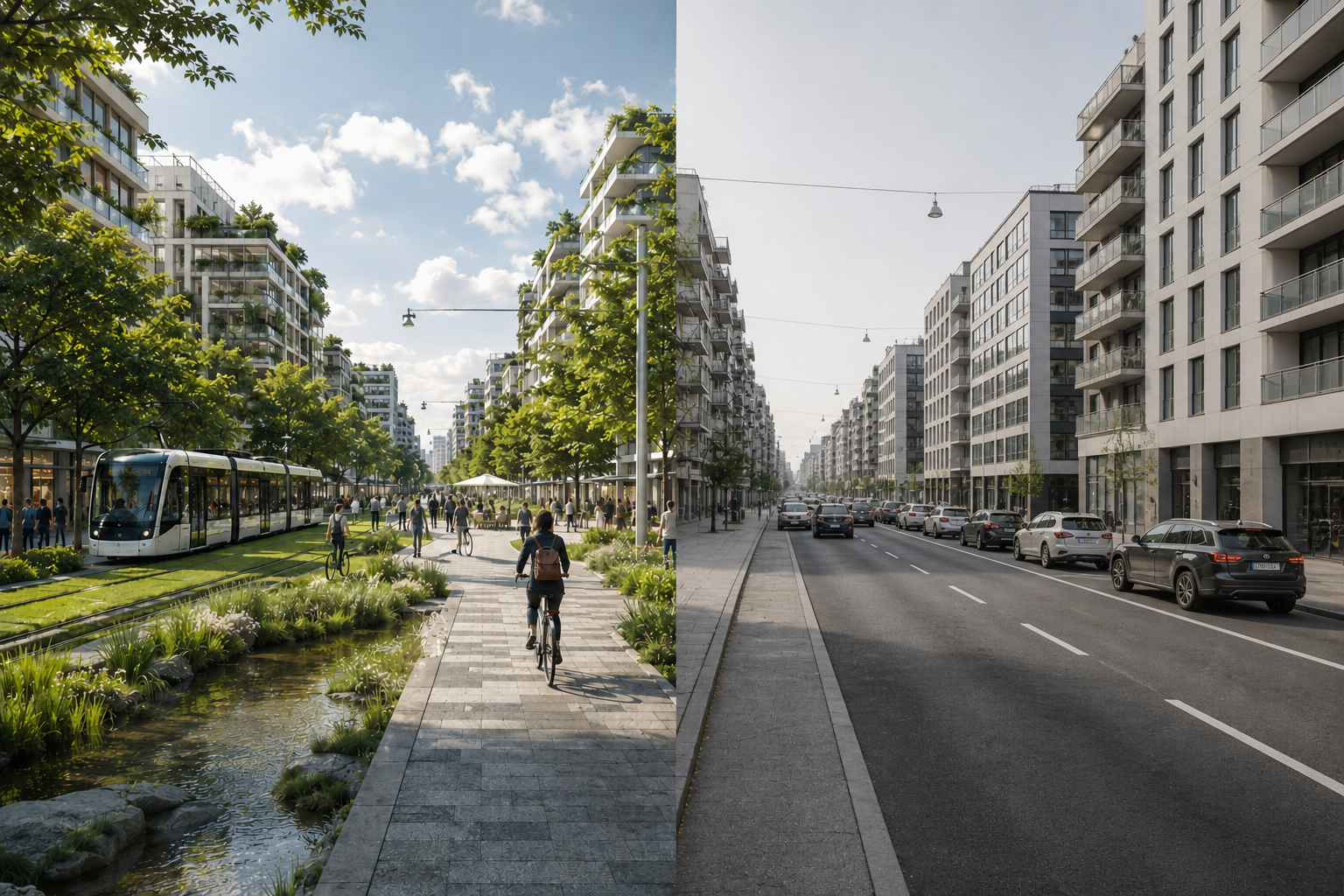
cover image created with the help of AI tools