
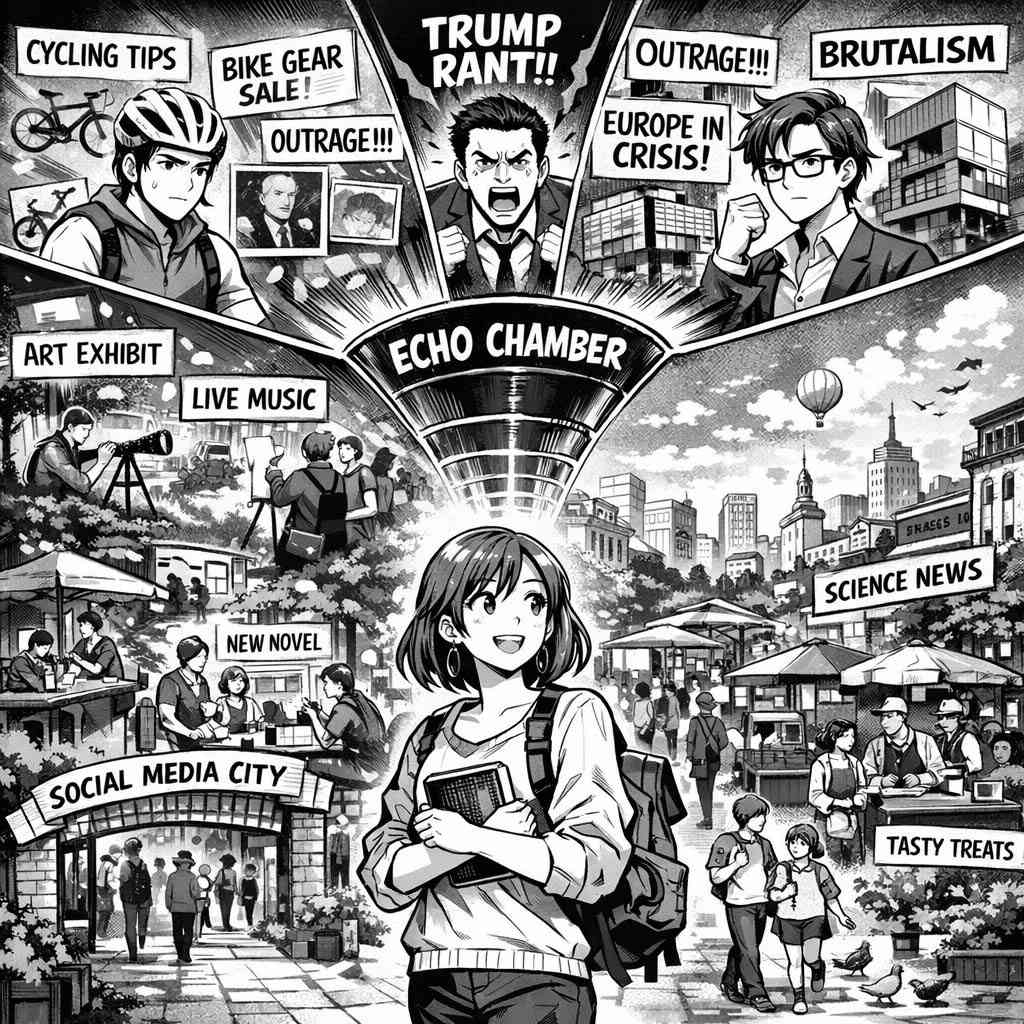
Why Social Media Feels Like a Monofunctional City
The pattern is always the same. You scroll through a social media platform or a video platform, or you buy something online, and within hours the world begins to shrink. The algorithm decides what you are now. One cycling video and suddenly your life is bib shorts, cadence drills, and endless bikepacking reels. One political clip and the feed locks you into permanent outrage: Donald Trump, the madness of the news cycle, the rearming of Europe, the collapse of everything, on repeat. One architecture post and you are trapped forever in brutalism nostalgia and renderings of buildings you have already seen a hundred times.
The experience is not enrichment. It is narrowing.
It is the opposite of what good media has always offered: an edited mix of the unexpected, the surprising, the horizon-extending. A newspaper does not assume that because you read one story about cycling you want cycling forever. It understands that human beings are plural. We contain multitudes. We want variety, interruption, contrast. We want to stumble into things we did not know we were interested in. Instead, the algorithm offers more of the same shit, over and over again, because repetition is profitable. It mistakes engagement for meaning. It does not ask what might make you wiser, only what might keep you scrolling. And the longer one stays inside these tunnels, the more one begins to notice: this is not just annoying. It is socially corrosive. The echo chamber is not only a personal boredom machine. It is an engine reshaping how societies see themselves.
So what would the alternative look like? Here is a thought experiment: what if we designed social media the way we design good cities?
Because from an urban planner’s perspective, today’s platforms are not just bad media environments. They are badly planned places.
If Social Media Were a City, It Would Fail the Planning Review
If social media platforms were cities, most of today’s big platforms would be instant disasters: monofunctional, segregated, over-optimized, hostile to complexity. They are built like logistics zones, not like places for human life. Endless highways of content with no public squares, no serendipity, no reason to linger except consumption or outrage.
Cities, at their best, work differently. A good city is not an echo chamber. It is a space of encounter. So what would a platform look like if it acted like a good city?
1. Mixed Use Instead of Single-Use Zoning
Good cities reject monocultures. No planner would design a city that is only offices, only housing, or only shopping malls. We know the result: dead zones, boredom, fragility.
Yet this is exactly what algorithms do. You show interest in one topic and your feed is instantly rezoned into a single-use district: cycling-only, politics-only, architecture-only. The digital equivalent of being trapped in an endless business park. A city-like platform would insist on mixed use. Your feed would be deliberately heterogeneous. Politics alongside culture. Architecture alongside ecology. Seriousness alongside play. Familiar interests balanced with unexpected detours.
Diversity would not be an accident. It would be policy.
2. Editorial Planning Instead of Pure Optimization
Cities are not planned solely by traffic engineers. They involve designers, sociologists, historians, and planners who make value judgments about what creates livability.
A city-platform would reintroduce editorial intelligence. Not censorship, but curation. Algorithms could assist, but not dominate. Think of them as infrastructure, not ideology.
Editors would ensure balance, just as planners ensure neighborhoods do not collapse into monocultures.
3. Public Squares Instead of Endless Highways
Most platforms today are highways: infinite scroll, maximum speed, no stopping.
Good cities create plazas, parks, benches—places where you encounter difference and linger without being pushed to consume. A city-platform would have shared public spaces: common feeds curated for civic life, not for outrage. Spaces where people still inhabit a sense of a shared world.
Without public squares, you do not get citizens. You get isolated commuters.
4. Friction as a Feature
Planners know that friction is not always bad. Speed is not always good. Cities use traffic calming for a reason.
A city-platform would introduce friction deliberately: fewer notifications, slower refresh cycles, prompts asking “Do you want something different?” or even “You’ve been here long enough.”
The goal would not be addiction. It would be humane pacing.
5. Serendipity by Design
The best cities are full of unplanned encounters. You take a wrong turn and find something wonderful.
Algorithms hate wrong turns. A city-platform would hard-code serendipity: cross-topic bridges, curated randomness, content from outside your comfort zone—not because it triggers outrage, but because it expands horizons.
Digital street life instead of digital tunnels.
6. Social Mix Instead of Algorithmic Segregation
Urban planning has spent decades fighting segregation because we know what it does: it fractures society.
Algorithms segregate constantly—ideologically, culturally, emotionally. They cluster like with like until polarization becomes structural. A city-platform would actively counter this by exposing users to adjacent differences, overlapping concerns, shared problems seen from multiple angles.
Plurality is resilience. Echo chambers are intellectual slums.
7. Better Metrics: Livability Over Traffic
Good cities are not judged by how fast people move through them, but by livability, health, cultural richness, cohesion.
Platforms today measure only engagement minutes. A city-platform would measure diversity of exposure, reported surprise, time spent away living actual life. It would optimize for citizens, not captives.
Yes, it would be less profitable. That is the point.
Designing for Citizens, Not Users
The crisis of social media is a planning crisis. These platforms are designed for extraction, not habitation. For throughput, not life.
A social media platform designed like a good city would treat people not as users to be captured, but as citizens to be supported. It would assume that human beings are complex, curious, and capable of handling more than one idea at a time.
The city teaches us this: diversity creates resilience, friction creates meaning, and shared spaces create society. If we ever want a digital public realm worth inhabiting, we should stop building content highways and start planning places. Because the world is wider than your feed.
And reality, thankfully, is still bigger than the algorithm – maybe it is time to rethink whether we should not have building codes or design guidelines for algorythms as well.
Cover image created with the help of AI tools


