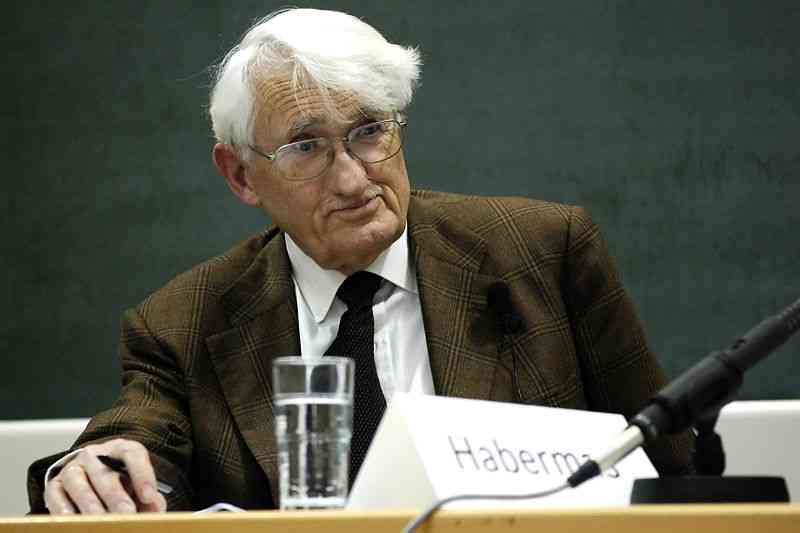
Jürgen Habermas has died, and with him one of the last great figures of a generation of philosophers who still believed that thinking could help society understand itself. For many readers he was a demanding thinker – precise, rigorous – sometimes almost stubbornly committed to the slow work of reason. Yet behind the density of his arguments was a simple and hopeful conviction: that human beings, if given the chance, can talk to one another in ways that allow societies to find direction together.
For those of us who work with cities, this belief has always had a particular resonance. Habermas rarely wrote about urbanism directly, but the city quietly runs through his thinking like a hidden foundation. The public sphere he described was born in cities. The communicative exchanges he valued unfold most visibly in streets, squares, cafés, and council chambers. The democratic life he defended requires precisely the kinds of encounters that urban space makes possible.
Urbanists often turn to philosophy looking for concepts, frameworks, or justifications. But philosophy can offer something more subtle: a way of seeing the city differently. Habermas provided such a lens. He taught us to understand society not only as an economic system or an administrative structure, but as an ongoing conversation among citizens. And cities, perhaps more than any other human environment, are places where that conversation becomes visible.
Habermas’s early work on the public sphere described how, in the eighteenth century, citizens began gathering in coffeehouses and salons to debate literature and politics. These were modest places in the urban landscape, yet they hosted a transformation in political culture. Private individuals began to form public opinions. Authority could be questioned. Arguments could circulate.
In retrospect, these spaces were not merely historical curiosities. They reveal something essential about cities: that urban environments create the conditions for public reasoning. Density, proximity, and diversity produce encounters. Encounters generate discussion. Discussion, when it becomes shared and visible, becomes politics.
Urban design is rarely described in these terms. We speak of mobility systems, land-use patterns, densities, and typologies. Yet through Habermas’s perspective, one begins to see something else. The city is not only a spatial structure. It is also a framework that allows society to talk to itself.
The plaza, the boulevard, the park bench, the local café – these are not just amenities. They are the quiet infrastructures of the public sphere.
Habermas later distinguished between two ways societies organize themselves. One operates through systems: money, markets, bureaucracies, and administrative power. The other operates through communication, through the slow and sometimes messy process of reaching understanding with one another.
Cities live constantly in the tension between these two logics. Urban development, especially today, often follows the rationality of systems. Investment flows determine land values. Infrastructure follows efficiency models. Planning procedures become technical exercises.
Yet the life of the city itself—what happens between residents, neighbors, strangers – belongs to another register. Here people explain themselves, negotiate differences, express dissatisfaction, and imagine alternatives. Here the city becomes a place where shared meaning is produced.
Habermas warned that the systems of modern society could gradually colonize this communicative realm. When that happens, social life becomes reduced to transactions and regulations. One sees this clearly in cities where public spaces become privatized, where housing becomes primarily an investment instrument, or where planning reduces urban life to performance metrics.
For an urban designer, Habermas’s work offers something quietly powerful: a reminder that design is never only about form. It is about the conditions under which people encounter one another and exchange ideas. Philosophy, in this sense, becomes a design tool – not in a technical sense, but in a way that sharpens our understanding of what cities are for.
A well-designed square is not simply beautiful; it allows strangers to gather. A permeable street network does more than move traffic; it creates the possibility of chance encounters. Transparent civic institutions do more than administer; they invite citizens into the process of collective decision-making.
Habermas gives us a language to understand these qualities. He reminds us that democratic life depends on spaces where arguments can appear, circulate, and be challenged. In this way, philosophy becomes a companion to urban design, helping us articulate why certain spatial arrangements feel more open, more civic, more democratic than others.
What made Habermas remarkable was not only his intellectual rigor but also his persistence in defending the possibility of rational dialogue. At a time when public discourse often appears fragmented or cynical, he insisted that societies still need places where arguments can be exchanged without domination.
Cities remain one of the last environments where this can happen in a tangible way. Online debates may travel faster, but they lack the physical coexistence that urban life imposes. Social media platforms amplify voices but also fragment attention, creating echo chambers where people mostly encounter opinions that mirror their own. Algorithms reward outrage and speed rather than careful reasoning. The result is often a noisy but strangely isolated form of discourse.
The city offers something different. In physical space we encounter people who are not part of our digital networks. We see faces, gestures, and reactions. Disagreement becomes embodied rather than abstract. A protest on a square, a debate at a town hall, a conversation overheard at a café – these experiences remind us that public life is not only a stream of messages but a shared presence.
Habermas’s idea of the public sphere becomes particularly relevant here. The city provides the material conditions for a debate that cannot be fully replaced by digital communication. Public squares, streets, and civic buildings remain places where arguments appear visibly and where citizens recognize themselves as part of a collective.
That is why the city remains, perhaps more than any institution, the spatial expression of the public sphere.
With Habermas’s death we lose a thinker who believed deeply in the civilizing power of discourse. Yet his ideas continue to resonate every time a city square fills with protest, every time neighbors gather to discuss the future of their street, every time citizens argue passionately about what their city should become.
For those who design and think about cities, his legacy leaves us with a quiet but demanding task. Habermas taught us that democracy is not a finished structure but an ongoing practice of communication. It requires spaces where people can meet, speak, disagree, and listen. The design and governance of cities therefore carry a responsibility that is larger than aesthetics or efficiency.
What we learned from Habermas is that the city must remain open to argument.
Our task, going forward, is to protect and cultivate the spatial conditions of that argument: streets that invite encounter, squares that allow assembly, institutions that remain transparent, and planning processes that treat citizens not as obstacles but as participants in a shared conversation.
If we succeed in doing this, the city will continue to perform the democratic work Habermas described. It will remain a place where society does what he believed it should never stop doing: thinking aloud about its common future.