The 61st ISOCARP World Planning Congress has come to a close. Time to reflect. What lingered with me was not the polished diagrams or the neat vocabulary of resilience and quality of life, but the quiet moments when familiar assumptions cracked open. In the corridors, after sessions, in the pauses between arguments, it became clear that our existing categories for thinking about cities — growth, density, mobility, even sustainability — are starting to feel strangely inadequate for the world rushing toward us. We somehow lack the vocabulary of the future of cities in all their complexity.
What interested me most were the ideas that slipped between the structured discussions: stray comments about planetary instability, whispered doubts about technological optimism and AI, unguarded reflections on the limits of planning. These fragments suggested that the truly radical future may not lie in refining our current tools, but in reimagining the very terrain on which our cities stand — culturally, ecologically, materially.
This essay emerges from that threshold. It is not a record of the congress, nor a manifesto. It is a meditation on how the city of tomorrow might grow from the cracks of today, not as a utopia but as a shifting, semi-wild organism negotiating with forces far larger than itself. It explores the possibility that the urban future will be neither controlled nor predictable — and that this may be its greatest strength.
The City of Tomorrow as a Living Palimpsest
The city of tomorrow will not announce itself with fanfare. It will infiltrate what already exists — the alleys, courtyards, roofs, and infrastructural residues where the present city begins to loosen. We often imagine the future as a dazzling alternative to what we have, but perhaps it will emerge as something far stranger: an unruly cohabitation of inherited forms and unexpected evolutions.
Rather than wiping the slate clean, the future city will write over the old text, leaving traces of what came before. It will not be elegant. But it will be alive.
Porosity as Urban Transformation
Today’s cities still cling to a logic of boundaries — doors that close, façades that separate, infrastructures that divide. But the city of tomorrow may refuse such solidity. It may prefer membranes to walls, thresholds to edges, ambiguity to certainty.
Imagine buildings that inhale and exhale, walls that shift opacity with the weather, streets that blur into interiors. This is not architecture for spectacle; it is architecture learning to behave like climate, like biology, like something that refuses to be stable.
In this porous city, urban life becomes atmospheric. Publicness is not defined by property lines but by shifting conditions: shade, breeze, light, sound, proximity. Spaces appear and dissolve as circumstances change.
Ecological Wildness as Urban Logic
The future city will not tidy up nature; it will allow nature to unsettle it. Instead of polished green amenities, we might coexist with wetlands creeping back into industrial zones, insects orchestrating micro ecologies on rooftops, mosses rewriting surface textures.
Urbanism will become less about controlling ecological processes and more about entering into conversation with them — and sometimes surrendering. Periodic flooding may shape architectural rhythm. Nighttime humidity might determine public life. Urban maintenance crews may resemble stewards of hybrid ecosystems rather than managers of built form.
This is not the picturesque “green city.” It is the city that admits it is part of a larger metabolism.
Time as a Design Material
The city of tomorrow will no longer exist in a single temporal layer. Instead, it will operate like an accordion — expanding, contracting, slowing, accelerating — always negotiating with climate, culture, and collective need.
A square may be a shaded refuge at midday and a heat-harvesting field at night. A warehouse may switch between energy storage and cultural gathering. A street may alter its porosity with the season, thickening into a sheltered corridor during sandstorms or dissolving into open air in winter.
Temporal elasticity may become the city’s most sophisticated form of resilience.
Governance Beyond Human Hands
As machine intelligences weave themselves quietly into urban processes, a new kind of governance may arise — not replacing humans, but unsettling the idea that humans alone direct the city.
Algorithms may mediate microclimates. River systems may dictate land use through real-time ecological performance. Buildings may negotiate their own energy exchanges. Planning could become a three-way conversation between human judgment, intelligent systems, and environmental actors — a polyphonic governance that resists hierarchy.
This is not the “smart city.” It is the sentient city — or at least a city learning to sense.
Metamorphosis Rather Than Replacement
The future city does not require a blank canvas. It requires attention to the overlooked. The rooftops that wait for new atmospheres. The infrastructure corridors that could host distributed ecologies. The informal repair cultures that model circular economies better than any policy paper.
It grows from improvisation rather than imposition, from latent potential rather than clean-sheet planning. Its identity will be unstable, layered, and contradictory — but this instability may be its deepest source of resilience.
A City That Remains Open to the Unforeseen
The city of tomorrow is not a destination. It is a condition of openness — to climate, to non-human agency, to technological ambiguity, to social reinvention. It resists the fantasy of perfect efficiency and instead embraces friction as a generative force.
The most striking future is not the one that looks new, but the one that feels awake.
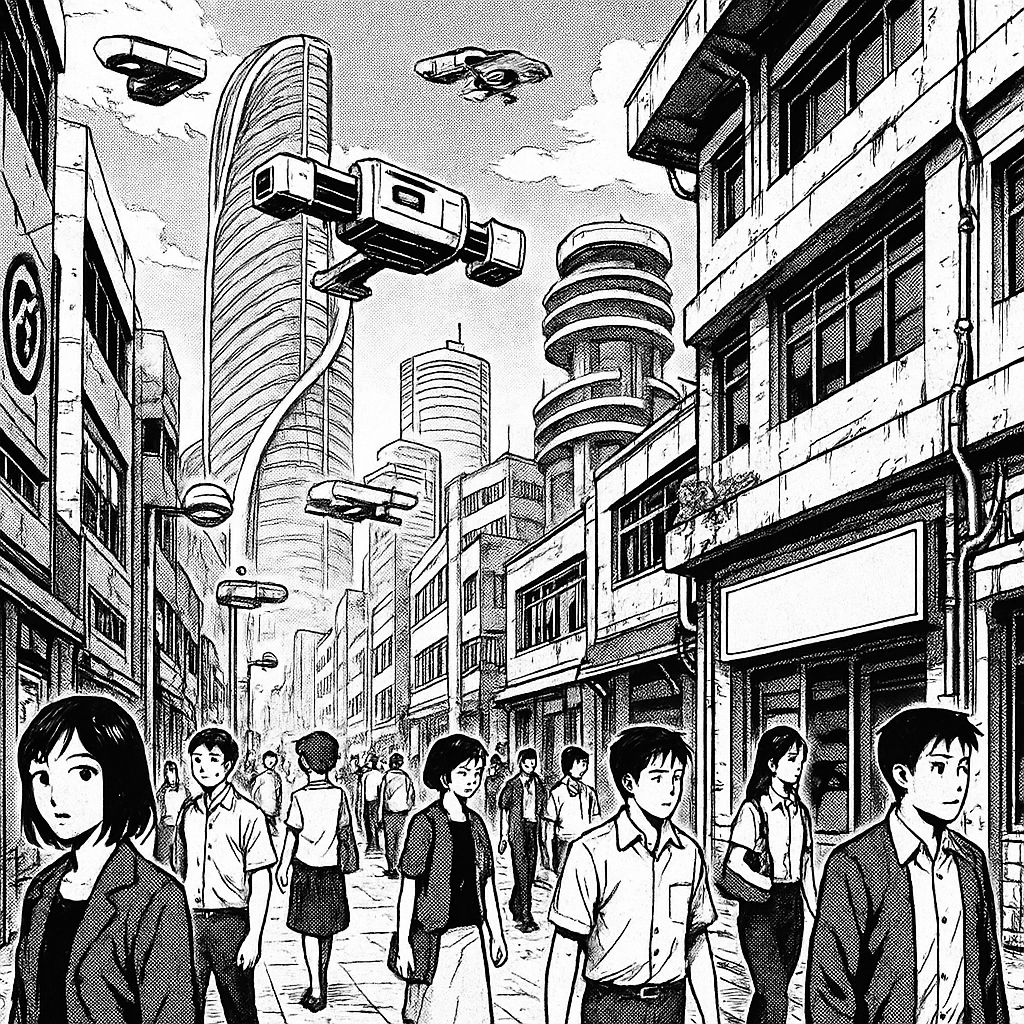
Cover image created with the help of AI tools