How migration politics is drifting away from urban reality—and what that means for policy and design
Cities are being asked to solve problems they did not create—and are denied the tools to address.
Across much of the Western world, national governments are tightening immigration rules. Thresholds go up. Pathways narrow. Temporary visas are capped or curtailed. Borders become political symbols of control. This is often presented as a necessary response to housing shortages, stretched services, or social cohesion. Yet almost all of the real impacts of these decisions land somewhere else.
They land in cities.
Cities are where migrants live. Where they work. Where they staff hospitals, care homes, construction sites, logistics hubs, restaurants, and universities. Cities are where population growth is absorbed, where housing demand materialises, where integration actually happens—or fails. And yet cities have remarkably little influence over migration policy. This mismatch between who decides and who deals with the consequences is becoming one of the most important structural risks to urban futures in the West.
Migration is no longer just a border issue—it is an urban systems issue
For much of the twentieth century, migration policy could be treated as a national concern with limited spatial differentiation. That is no longer true. In today’s economy, cities are the primary engines of growth, innovation, and service provision. They are also the primary sites of demographic change. Migration, in practice, is a form of urban infrastructure: it supplies labour, sustains population balance, and underpins economic complexity. When migration is restricted, cities do not experience this as an abstract macroeconomic adjustment. They experience it as staff shortages, delayed projects, higher costs, and declining service quality. Care systems struggle to recruit. Construction slows just as housing shortages intensify. Universities lose students who once fed local talent pipelines. Service economies hollow out at the edges. Over time, these pressures compound. What makes this particularly problematic is that restriction is rarely paired with compensating policy design. Housing systems are not reformed at scale. Productivity strategies remain aspirational. Automation fills some gaps but not others. Cities are expected to adapt, absorb, and improvise.
Two urban models are emerging—and they are moving apart
Globally, two distinct approaches to migration and urban development are taking shape. In much of the West, a constraint model is emerging. Migration is politically capped or slowed, while cities continue to rely on it structurally. The result is friction: between labour demand and supply, between demographic reality and political narrative, between urban systems and national policy. Elsewhere, a facilitation model dominates. In parts of the Middle East, Asia, and increasingly Africa, migration is treated as a strategic input to urbanisation. Labour, skills, and students are enabled—sometimes aggressively—to support growth, infrastructure delivery, and global positioning.These systems are far from perfect. Many are deeply unequal. But they are internally coherent: urban ambition is matched with mobility. Western cities increasingly operate without that coherence.
Why politics keeps missing the city
If cities depend so clearly on migration, why is policy moving in the opposite direction?
The answer lies in political geography. Across the US, Europe, and Australia, attitudes toward immigration are consistently more negative in rural and non-metropolitan areas than in large cities. This is not because rural areas experience more migration—often they experience far less—but because migration is encountered symbolically rather than practically. In cities, migration is normalised through daily contact. Outside cities, it is filtered through national media, political rhetoric, and cultural anxiety. Migration becomes a proxy for housing frustration, service decline, and loss of institutional trust.
Electoral systems amplify this dynamic. Rural areas are often over-represented politically. As these constituencies push for restriction, national governments respond—even when doing so conflicts with the operational needs of cities. The result is a structural misalignment: urban economies depend on migration, but migration policy responds to non-urban sentiment.
What this means for urban policy and design
For planners, city leaders, and policymakers, the implications are profound. You cannot design housing systems, transport networks, care infrastructure, or labour strategies without factoring in migration. Yet cities are increasingly asked to do exactly that—to plan for growth while having limited control over one of its key drivers. This creates a dangerous pattern: cities are blamed for outcomes—overcrowding, housing stress, service pressure—that are framed as failures of local management but are in fact symptoms of national policy mismatch. At the same time, a secondary narrative emerges: that cities are culturally “out of step” with the nation. This narrative often masks the real issue, which is not cultural divergence but functional divergence between where economies operate and where political decisions are made.
A brief word on culture—and why it matters, but not how you think
Cultural arguments often dominate migration debates, but they are rarely the root cause of policy failure. National identity is not a static system that can be preserved by slowing movement. It has always evolved—slowly, unevenly, and often through cities. Cities are where adaptation happens first, whether societies like it or not. When politics tries to freeze identity in an imagined past, it does not stop change. It merely delays adaptation, increasing friction when reality eventually intrudes. For urban policy, this matters less as philosophy and more as risk management. Societies that fail to adapt culturally tend also to fail economically and institutionally.
The question cities must now ask
The central question is no longer whether migration should be “high” or “low.” It is whether migration policy can be designed to align with urban reality.
If cities are expected to remain engines of prosperity, innovation, and care, they cannot be treated as collateral damage in national border politics. Migration is not an external variable to be managed at arm’s length. It is part of the operating system of modern cities.
Ignoring that does not protect stability. It quietly erodes it.
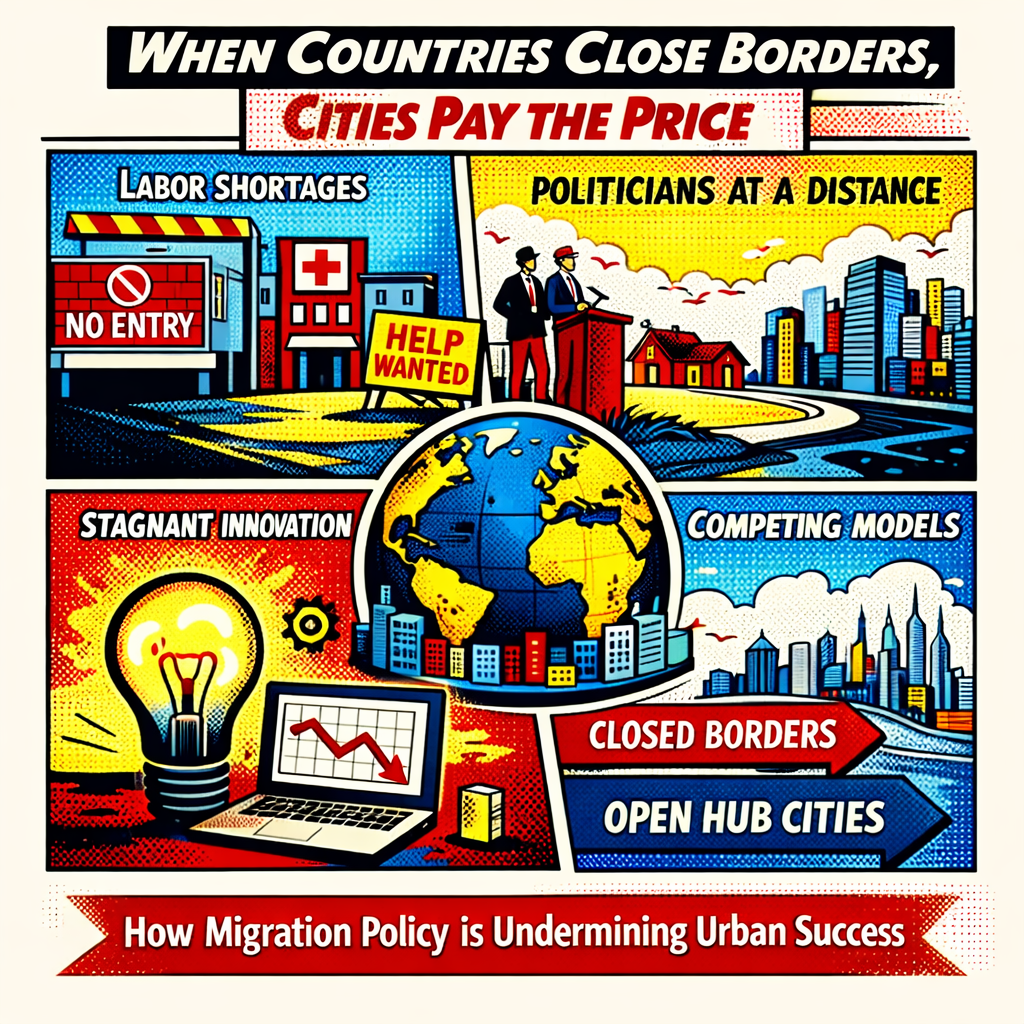
Cover image created with the help of AI tools.