What Happens When Your Car Isn’t Under Your Bedroom
I own cars in several cities where I live. That is a confession many urbanists are expected to preface with an apology. I will not. I use cars—for what they are good at. I use them to leave the city or to transport big or heavy things.
What is perhaps more surprising is where those cars are. In all cases, they are at least a five-minute walk from my front door. Sometimes more. They are never under my building, never one elevator ride away, never waiting like a loyal appliance. And that distance, that small but tangible effort, turns out to be one of the best mobility decisions I have ever made.
Because of it, the most convenient and fastest mode of transport for almost everything I do in the city is walking. Close behind come cycling and public transport. The car, by contrast, requires intention. Shoes on, jacket zipped, a short walk through the neighborhood. That friction is not a bug—it is a feature. It introduces just enough effort to make me ask a question before every trip: Do I really need the car for this? Most of the time, the honest answer is no.
This is not about moral superiority or renunciation. It is about aligning infrastructure with behavior we claim to want. Cities everywhere say they want fewer car trips, more walking and cycling, and stronger public transport. Yet we continue to design housing as if the car were the default extension of the living room—hidden beneath every building, operated by private developers, bundled invisibly into the cost of housing.
Underground parking is sold as convenience. In reality, it is a powerful demand generator. When a car is two floors below your bed, driving becomes the path of least resistance—even for distances that would be faster on foot, by bike, or by tram. When the car is a short walk away, the hierarchy of modes quietly reorganizes itself.
This is why cities should stop requiring and subsidizing parking under every building and instead invest in district parking garages, operated by the city or a public utility, and deliberately placed at a modest walking distance from homes.
We already know this works.
- Freiburg’s Vauban district is a classic example. Most housing is effectively car-free; residents who own cars must rent a space in collective garages at the edge of the neighborhood. The result is not an anti-car utopia but a place where streets belong to children, cyclists, and everyday life—and where car ownership, while possible, is no longer frictionless.
- Vienna has quietly moved in a similar direction with neighborhood garages and reduced parking minimums, decoupling parking costs from housing costs.
- Zurich has long practiced strict parking caps combined with shared district facilities, making it easier to live without a car while still allowing access when needed.
- Copenhagen and Amsterdam, though often discussed only in terms of cycling, have also systematically shifted parking out of residential streets and buildings into shared structures, freeing space and reinforcing public transport, walking, and cycling as the default choices.
- Even Tokyo, paradoxically one of the world’s most car-efficient cities, demonstrates the same principle: parking is regulated, costly, and rarely bundled casually with housing. Car ownership is possible—but never effortless.
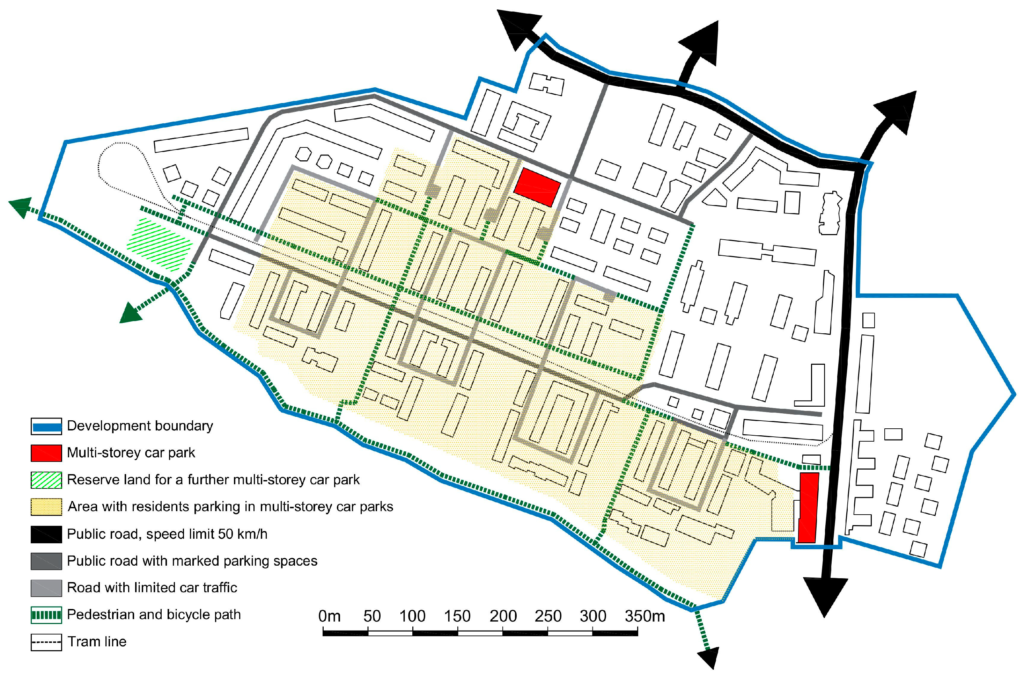
Source: Szumilas, A. Implementation of Solutions Reducing the Number of Cars in Polish Housing Estates—Based on the Experience of the Vauban Estate in Freiburg, Case of the City of Wroclaw. Buildings 2024, 14, 712. https://doi.org/10.3390/buildings14030712
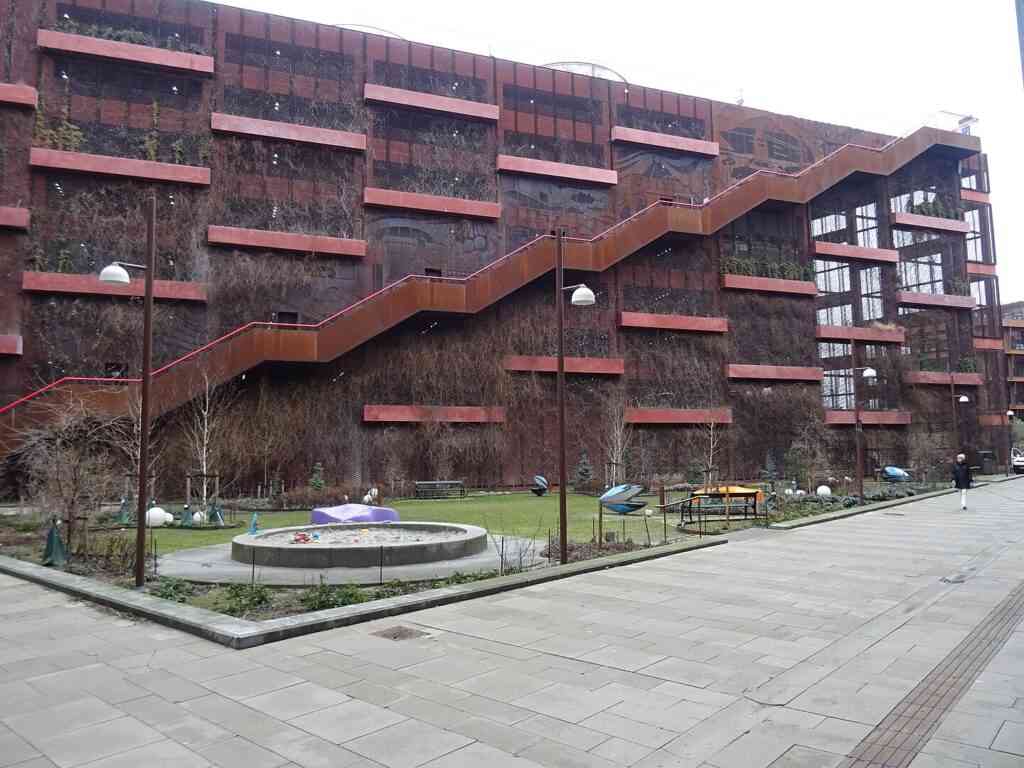
Source: wikimedia.org
The advantages of district parking garages go far beyond mobility.
First, they make housing more affordable. Underground parking is extraordinarily expensive. Depending on geology and design, a single space can cost as much as a small apartment to build. Those costs do not disappear; they are folded into rents and sales prices, forcing even households without cars to pay for infrastructure they do not use. Removing mandatory underground parking and replacing it with optional, paid district facilities is one of the most direct ways cities can reduce construction costs without lowering standards.
Second, district garages age better than mobility forecasts. Private underground parking locks a building into a 50- to 100-year assumption about car ownership. Publicly operated district garages, by contrast, are flexible assets. As car ownership declines, they can be repurposed—into logistics hubs, workshops, mobility centers, or even housing. Try doing that with two basement levels under a condominium.
Third, they align with how mobility is actually changing. The future is not car-free; it is car-selective. People will still need cars for regional travel, family logistics, and specific professions. But they will use them less often, rely more on public transport, and combine it seamlessly with walking and cycling. District garages support this hybrid reality far better than private parking hidden under every building.
Finally—and this is perhaps the most important point—they change the psychology of everyday movement. When walking, cycling, and public transport are simply easier than driving, people do not need to be convinced. They just act accordingly. My own daily behavior is proof enough. I still own cars. I still appreciate them. But I no longer reach for them by default.
Cities are shaped less by grand visions than by small, repeated choices embedded in concrete and asphalt. A five-minute walk to a car may seem trivial. In practice, it is transformative.
If we are serious about livable cities, affordable housing, and realistic transitions in mobility, then the plea is simple: stop burying cars under our homes. Put them where they belong—nearby, accessible, but not effortless. Let walking, cycling, and public transport win by being what they already are: the most convenient ways to live in a city.