The exhibition halls of the Global AI Show in Riyadh I visited last week were full of certainty. Every stand promises better predictions. Better optimisation. Better decisions. Better control. Artificial intelligence, we are told, will eliminate uncertainty. I would argue the exact opposite.
The greatest value of AI is not that it makes us more certain. It is that it should make us less certain. That may sound like a contradiction. It isn’t.
For centuries, planning has been built around certainty. We forecast population growth, calculate traffic volumes, estimate housing demand and draw masterplans that assume a single future. Every planning document is, in essence, a carefully constructed prediction. We spend years trying to convince ourselves that we know what tomorrow will look like.
Reality, of course, rarely cooperates. Pandemics happen. Wars happen. New technologies emerge. Climate events rewrite the assumptions on which entire cities were planned. Demographic shifts surprise us. Economies boom and collapse. Every generation discovers that its certainty was little more than confidence dressed up as science.
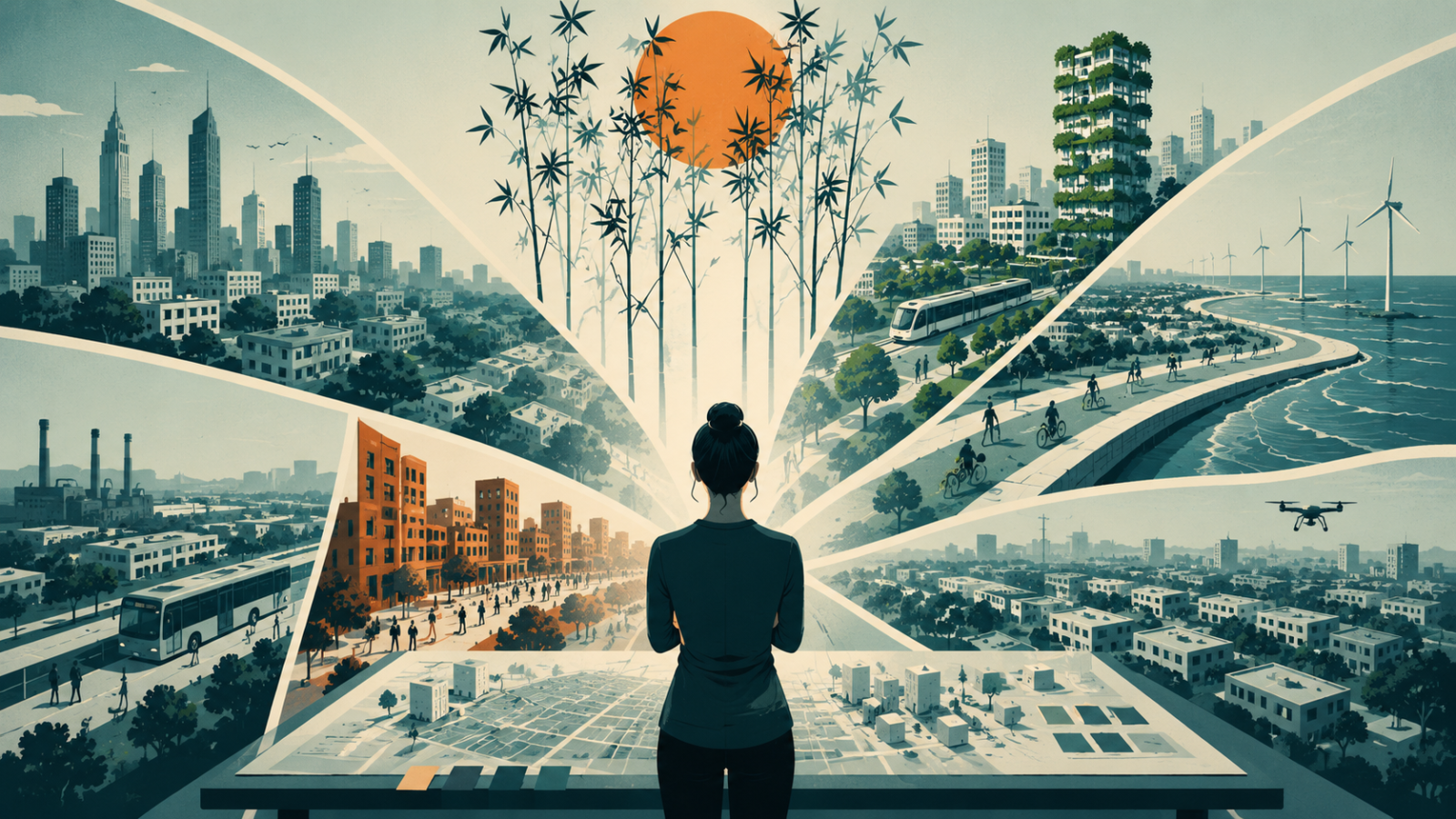
Artificial intelligence changes this relationship with the future. Not because it predicts tomorrow more accurately, but because it allows us to imagine many tomorrows simultaneously.
For the first time, planners can test hundreds of scenarios instead of defending one. Governments can explore the consequences of alternative policies before committing billions to infrastructure. Cities can ask not “What will happen?” but “What could happen?” That is a profound shift. The real revolution of AI is not prediction. It is exploration.
This requires a different mindset. Much of today’s AI industry is built around selling confidence. Dashboards promise certainty. Algorithms promise optimisation. Marketing promises the right answer. Cities, however, are not multiple-choice exams. They are messy, political, emotional and wonderfully unpredictable places where millions of individual decisions interact every day. No algorithm will ever fully capture why one neighbourhood flourishes while another struggles. No model can perfectly predict where innovation will emerge or where people will unexpectedly choose to live, work or gather.
The purpose of AI should therefore not be to remove uncertainty. Its purpose should be to help us navigate it.
This also changes the role of the planner. There is growing anxiety that artificial intelligence will replace professions built around analysis and judgment. Urban planning is no exception. I see the opposite happening: planning has always been an exercise in intelligence. We collect information, recognise patterns, imagine futures and balance competing interests under uncertainty. AI does not replace these tasks. It amplifies them.
The future is not AI instead of planners. The future is planners with AI. This matters because cities are not engineering problems waiting to be solved. They are social contracts negotiated every single day. This is why I also worry about another fashionable word in the AI world: optimisation.
Everyone wants to optimise cities: Optimise traffic, optimise energy, optimise land use, optimise public services. Optimisation sounds rational until we ask a simple question: optimise for what? A city is not a logistics warehouse.
Some of the best cities in the world are gloriously inefficient. Public squares invite people to linger instead of moving as quickly as possible. Historic neighbourhoods resist geometric perfection. Parks occupy land that could generate far greater financial returns. Redundancy in transport systems creates resilience when one route fails. Diversity creates innovation precisely because it refuses to be optimised. Cities are not machines. They are places where people live their lives. Artificial intelligence should therefore optimise decisions, not cities.
Perhaps that is the conversation we should be having as AI moves from research labs into city halls. Not how certain AI can make us, but how much more curious it can make us. Because the future has never belonged to those who were most certain but to those who were most prepared for uncertainty.
If artificial intelligence helps us embrace that uncertainty rather than hide it, it may become the most important planning tool we have ever developed.
Cover image AI generated