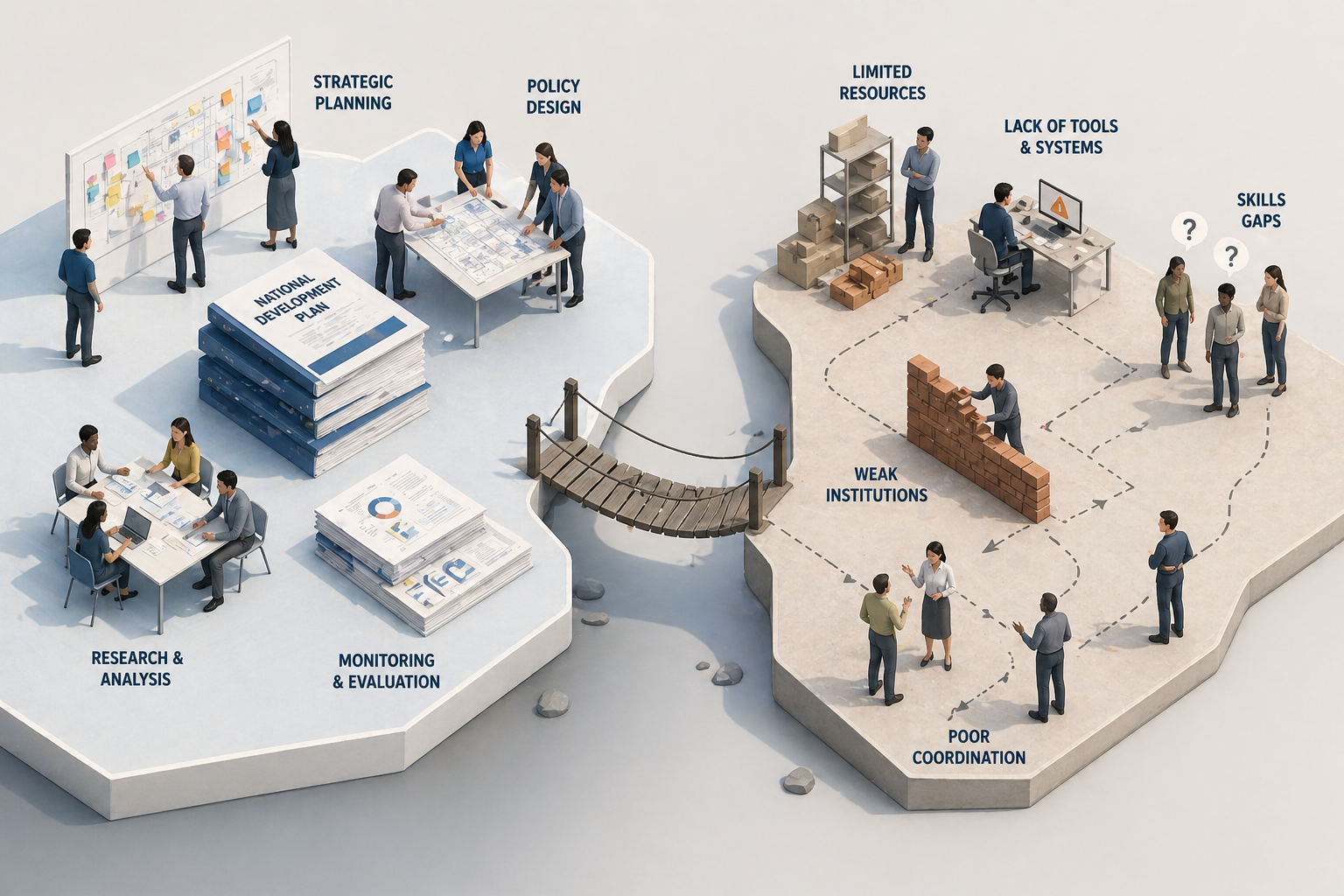
There is no shortage of plans. Masterplans, strategic visions, policy frameworks, pilot projects – they exist in abundance, often produced with impressive technical rigor and supported by international expertise. Shelves are full, servers are crowded, and presentations circulate endlessly between ministries, agencies, and consultants. Yet the distance between what is planned and what is delivered remains stubbornly wide. The problem is not imagination. It is capacity.
In many resource-rich countries, this gap has a particular character. Wealth derived from oil, minerals, or other extractive industries has allowed states to finance ambitious projects without necessarily cultivating the institutional depth required to implement them. Revenues arrive independent of a broad-based, diversified economy. They do not depend on the slow accumulation of entrepreneurial knowledge, nor on the dense networks of small and medium enterprises that, elsewhere, form the backbone of problem-solving capacity. As a result, planning becomes an exercise that can be outsourced, while implementation remains an internal weakness that cannot.
This imbalance produces a peculiar form of dependency. Governments commission world-class plans from global firms, often at significant cost, yet lack the administrative continuity, technical expertise, and procedural clarity needed to translate these plans into reality. Each new project risks starting from scratch, because institutional memory is thin and turnover is high. Lessons learned are rarely codified. Systems are not refined over time. Instead, complexity accumulates faster than the ability to manage it.
Complexity is, in fact, the central challenge. Contemporary urban and infrastructural development is no longer a matter of single projects delivered by a single authority. It requires coordination across sectors, scales, and time horizons. Land use must align with transport. Infrastructure must anticipate demographic change. Climate adaptation must be integrated into everything. This is not simply a technical puzzle but an organizational one. It demands institutions that can learn, adapt, and collaborate. Without these qualities, even the best-designed plans begin to fragment under the weight of competing priorities and unclear responsibilities.
Tools matter as well, though not in the narrow sense of software or technology alone. The tools that are missing are often procedural and organizational: clear permitting systems, transparent procurement processes, standardized data frameworks, and mechanisms for inter-agency coordination. Where these are absent or underdeveloped, decision-making slows, risks increase, and implementation becomes unpredictable. In such environments, complexity is not managed – it is avoided, deferred, or simplified in ways that ultimately undermine the original ambition.
There is also a cultural dimension. In economies shaped by resource wealth, the urgency to build long-term institutional capacity can be less immediate. When revenues are strong, inefficiencies can be absorbed. When external expertise is readily available, internal development can be postponed. But this approach has limits. As projects grow more complex and expectations rise, the cost of weak capacity becomes more visible. Delays, cost overruns, and underperformance are no longer exceptions; they become systemic features.
None of this suggests that planning itself is misguided. On the contrary, the existence of strong plans is an asset. It indicates awareness, ambition, and a willingness to engage with global knowledge. The challenge is to rebalance the equation. Investment must shift from producing plans to building the institutions that can carry them forward. This means developing professional cadres within the public sector, strengthening continuity across political cycles, and creating environments where knowledge is retained and refined rather than repeatedly imported.
It also requires a different relationship with external expertise. Consultants and advisors can play a valuable role, but only if their work is embedded within local systems that are capable of absorbing and extending it. Otherwise, each engagement risks becoming a standalone exercise, disconnected from what came before and what will follow.
Ultimately, the question is not whether countries can plan. It is whether they can govern complexity over time. This is a slower, less visible process than producing a masterplan, and it rarely attracts the same attention. But it is here, in the patient construction of institutional capacity, that the real work of development takes place. Without it, plans will continue to accumulate, and the gap between intention and reality will persist.
Cover image created with the help of AI