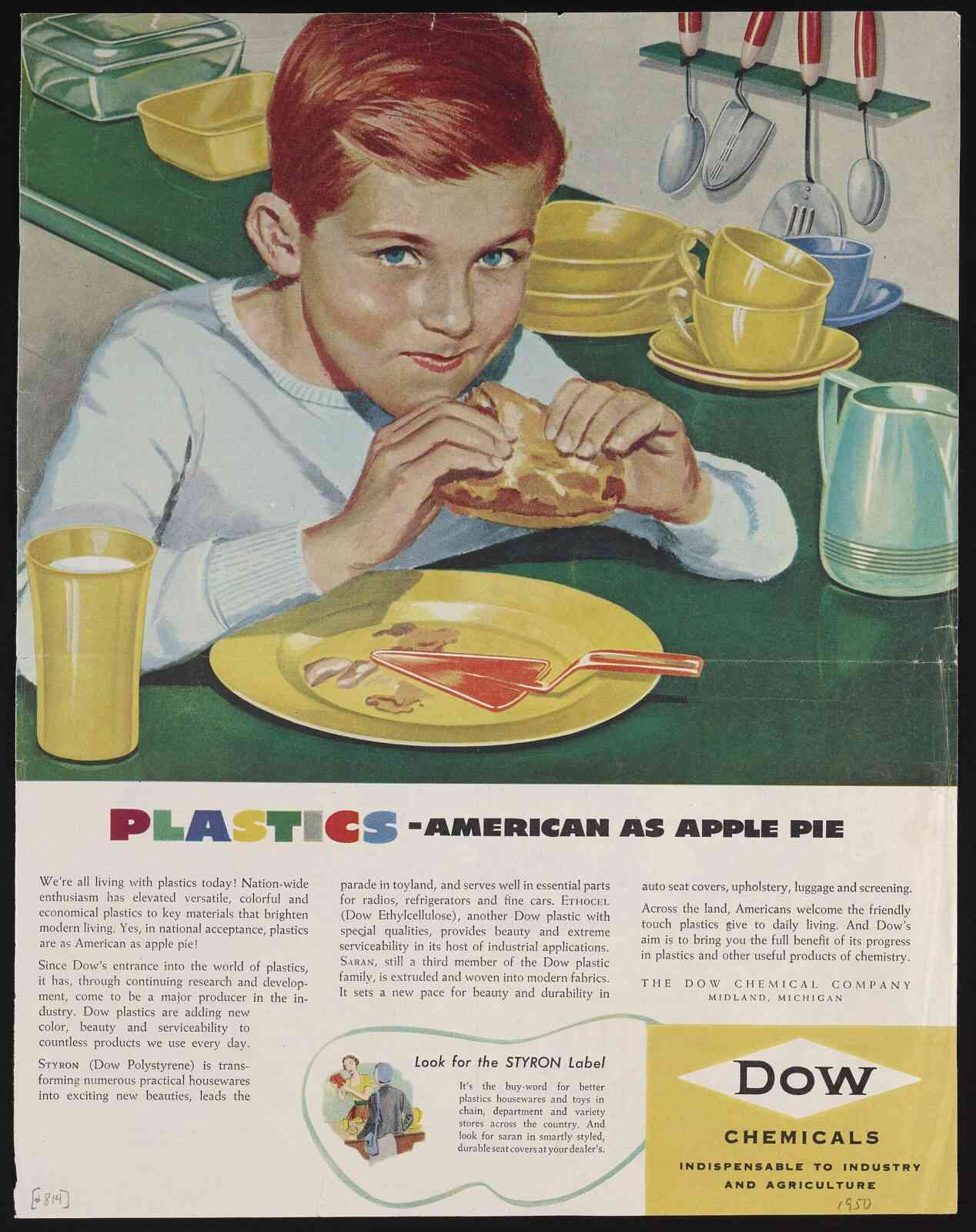
There was a time – not so long ago – when plastic was not only accepted, but enthusiastically celebrated as the material of the future: Imagine – the advertisement. A sunlit kitchen somewhere in the early 1970s, filled with soft colours and quiet optimism. A smiling family sits around a perfectly arranged table. Nothing breaks, nothing stains, nothing requires effort. Plates are light, cups are bright, cutlery is used once and then simply disappears into a bin. A reassuring voice explains that this is modern living: clean, efficient, effortless. No more washing, no more inconvenience, no more time wasted. Plastic, the message suggests, has finally aligned everyday life with the promises of progress.
Use it once – and throw it away. The elegance of that sentence lies in what it omits. Because nothing was ever truly thrown away. It was only moved.
Plastic did not fail as a material. On the contrary, it succeeded so completely that it reshaped the very logic of urban life. Its qualities – durability, flexibility, resistance to decay, low cost – made it the ideal companion for the modern city. It could protect, seal, transport, display, and standardise. It could respond to the increasing demands of density, speed, and hygiene. As cities grew larger and more complex, plastic quietly became the invisible infrastructure that allowed them to function with apparent ease. Food systems depended on it. Retail depended on it. Logistics, healthcare, construction – all absorbed it without resistance. What began as a convenience became a necessity, and eventually a default.
Yet the success of plastic contains a fundamental contradiction that cities have never resolved. The useful life of most plastic objects is extremely short, often measured in minutes, while their material life extends for decades or even centuries. The city operates on the assumption that disposal marks the end of an object’s existence, when in reality it marks the beginning of a much longer and far less controlled process. What appears as efficiency is, in fact, a displacement of time – a transfer of responsibility from the present to the future.
In no environment is this contradiction more visible than in the city itself. Urban life is organised around compression: compressed time, compressed space, compressed attention. Everything must move quickly, smoothly, predictably. Plastic enables this by removing friction. A meal can be packaged, transported, consumed, and discarded without interruption. A product can be protected and branded in a single gesture. Hygiene can be standardised across millions of interactions.
But each of these moments produces an object that outlives its purpose almost immediately. A salad is enclosed in a transparent container designed as much to display freshness as to preserve it, resembling a miniature aquarium of carefully arranged ingredients. A coffee is served in a cup lined with plastic to prevent leakage, ensuring that it cannot easily decompose. A delivery arrives wrapped in multiple layers of packaging, each one justified, each one destined for instant disposal. Individually, these objects appear trivial. Collectively, they form a system in which waste is not an unintended by-product but a structural outcome. Cities do not simply generate plastic waste. They are designed in a way that makes such waste inevitable.
What makes this condition particularly difficult to confront is the extent to which it is concealed. Modern cities are highly effective at maintaining an appearance of cleanliness and order. Waste is collected, sorted, processed, and removed from sight with remarkable efficiency. Streets remain clean, public spaces are maintained, and the system appears to function as intended. Plastic seems to disappear.
But disappearance is not the same as resolution. Germany offers a telling example of this hidden dynamic as the Guardian in a recent article reports. Despite its reputation for environmental responsibility and advanced recycling systems, it became the world’s largest exporter of plastic waste in 2025, sending more than 810,000 tonnes abroad in a single year. The destinations include countries such as Turkey, Malaysia, and Indonesia, where waste management systems are often under strain, leading to dumping, burning, or leakage into natural environments. What appears within Germany as a controlled and efficient system is, in part, sustained by exporting the problem beyond its borders. The city remains clean because its waste has been relocated. The system functions because it extends geographically, shifting its burdens to places where they become visible again. This is not an anomaly but a structural feature of the global plastic economy. Cities in wealthier regions externalise the consequences of their consumption, while cities in the Global South often confront those consequences directly. Here, plastic accumulates in streets, waterways, and informal dumping sites, not because it is used more, but because it cannot be made to disappear.
The effects are tangible and immediate. Drainage systems become clogged, increasing the risk of flooding. Public spaces are degraded by persistent waste. Informal economies emerge around the collection and sorting of discarded materials, often under precarious conditions. The material that once symbolised efficiency becomes a source of friction, slowing and obstructing the very systems it was meant to support. Plastic, in this context, does not simply pollute the city. It alters its functioning. And this is just the beginning. From there it enters rivers, the sea and comes back to us in the form of micro plastic, not just polluting the environment in between, but also ultimately poisoning our own body.
At the same time, plastic binds cities more tightly to a broader economic system that remains dependent on fossil fuels. Independent of the current economic impact this may have die to the high oil prices as a result of the conflict around the Strait of Hormuz, it is, fundamentally, a product of oil and gas, and its continued proliferation reinforces this dependency. Even as cities set ambitious targets for reducing carbon emissions, they continue to rely on a material whose production is intrinsically linked to those emissions. Recycling, while important, addresses only a fraction of the problem, as most plastic is not effectively recycled and new production continues to increase. This creates a deeper contradiction. Cities aspire to sustainability, yet depend on a material that embodies unsustainability. They aim for circularity, yet operate within systems that remain fundamentally linear. They project cleanliness and order, yet generate dispersed and persistent forms of pollution that extend far beyond their boundaries.
What makes plastic feel like a disease is not only its persistence, but its normalisation:
– It is no longer questioned.
– The plastic fork is expected.
– The plastic lid is assumed.
The packaging is invisible until the moment it is discarded – and even then, only briefly.
The system reproduces itself through countless small decisions, each of which appears rational in isolation. Convenience, hygiene, efficiency – all legitimate goals, all reinforced by design and expectation. And yet, taken together, they create a condition that is increasingly difficult to sustain.
Plastic spreads through the systems of the city, adapts to its demands, and persists within its environment in ways that resist easy solutions. It is both a product and a driver of the urban condition, embedded so deeply in everyday life that it becomes almost invisible. And like many systemic problems, it is sustained not by a single failure, but by a collective logic that remains largely unquestioned. The problem, ultimately, is not plastic itself. It is the model of urban life that made it seem indispensable.
cover image: wikimedia.org