Many urban planners have developed a habit they rarely question: the reflex to load every project with every possible virtue. Sustainability, resilience, inclusivity, net zero, circularity, walkability, car-free living, nature-based solutions, social equity – the list grows longer with every conference, every framework, every new acronym – from sponge city to the 15-minute neighbourhood. None of these ideas are wrong, which is precisely why they accumulate so easily. Because none can be rejected outright, all are included, and projects begin not with clarity, but with an overload of intentions that signal moral alignment rather than strategic focus.
What emerges is rarely a coherent plan. It is more often a declaration – a document that reassures everyone involved that all the right boxes have been ticked, while quietly avoiding the harder and more consequential question of what will actually be delivered. Clients sense this immediately. Not because they oppose the ambitions, but because they operate closer to the realities of implementation. They understand budgets, timelines, institutional limits, and maintenance burdens. Faced with a plan that promises everything, they rarely push back openly. Instead, they nod, approve, and proceed, fully aware that much of it will not materialize. From that moment on, the project is already compromised, even if nobody says it out loud.
What follows is a familiar pattern of gradual erosion. Public transport systems remain lines on a map because funding or governance structures never align. Green infrastructure is implemented beyond the capacity of those responsible for maintaining it. Car-free visions dissolve under political pressure or everyday necessity. Each element, defensible in isolation, becomes problematic in combination once delivery falters. The outcome is not neutral, and it is certainly not a softer version of the original ambition. It is often worse than doing less in the first place. A neighbourhood planned around transit that never arrives does not gracefully adapt – it defaults to cars, but without the spatial logic to support them. Streets become congested, public space deteriorates, and the original goal of reducing car dependence produces the opposite effect. A landscape designed as climate infrastructure that cannot be maintained does not quietly fail – it turns into an urban liability, with dead planting, exposed surfaces, and heat where shade was promised.
At this point, another dynamic sets in, one that is rarely acknowledged but widely practiced. Once ambitions have been publicly stated, they cannot easily be withdrawn. Projects have been branded, promises have been made, and expectations have been set. When delivery begins to fall short, the response is not to recalibrate the ambition, but to adjust the narrative. Reporting becomes selective, metrics are framed generously, and communication shifts from describing reality to managing perception. What cannot be delivered physically is compensated for rhetorically. The district is still presented as sustainable, green, inclusive – even if the evidence on the ground is partial at best.
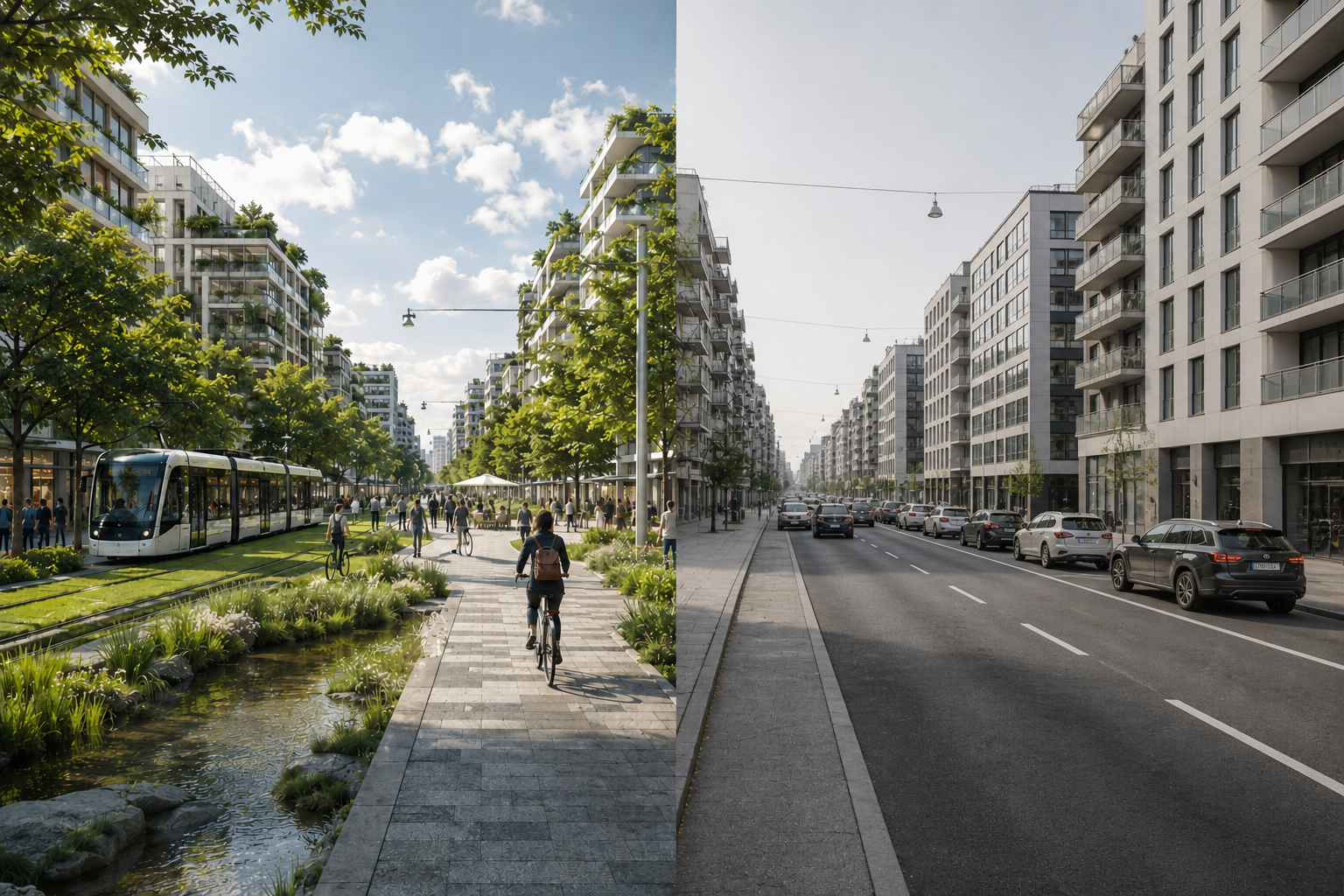
This gap between narrative and reality is sustained by the fact that many of these projects are experienced more through images, reports, and marketing material than through everyday use. For most audiences, the project exists as a curated representation. The shaded boulevard, the lively public space, the seamless mobility system – these are communicated convincingly, even when they are incomplete, underperforming, or in some cases absent. The result is a kind of parallel reality, where the project appears to comply with its ambitions on paper, while the lived environment tells a different story.
This is not a failure of communication. It is a consequence of overpromising at the outset. Once a project is framed as exemplary across multiple agendas, stepping back becomes reputationally difficult. And so the profession, together with its clients, drifts into a mode where maintaining the story becomes as important as, if not more important than, delivering the substance.
This is not a failure of ambition; it is a failure of discipline. Planning is not the art of stating everything that should be desirable. It is the discipline of making choices under constraint. Yet constraint is precisely what many plans try to wish away. The uncomfortable truth is that most projects cannot carry the full weight of the agendas we attach to them. Not financially, not institutionally, not operationally. Pretending otherwise does not expand capacity; it simply postpones the moment when reality intervenes, and when it does, it does so bluntly and without regard for the elegance of the original concept.
The profession therefore faces a choice. It can continue to produce plans that perform well in presentations but unravel in implementation, while being sustained by increasingly polished narratives, or it can accept that selectivity is not a weakness but a professional obligation. This requires a shift in mindset, beginning with a simple but often neglected step: stop starting with agendas and start with capacity. What can actually be built, funded, governed, and maintained in this specific place, with these specific actors, under these specific conditions? What systems already exist, and which ones can realistically be introduced? Where are the genuine levers of change, and where are the hard limits that cannot be negotiated away?
Only once these questions are answered does it make sense to reintroduce ambition in a meaningful way. Because ambition without delivery is not ambition at all – it is decoration. A bus system that can be implemented next year will do more for sustainable mobility than a rail network that remains a promise for decades. A robust, low-maintenance landscape will provide more climate resilience than an elaborate design that fails within a few years. A street that pragmatically balances cars and pedestrians will often outperform a car-free vision that never survives the approval process. These are not compromises; they are professional decisions grounded in reality.
Urban planning needs to rediscover a certain sobriety. Not the abandonment of ideals, but control over them. The ability to say: not here, not now, not like this. That is far more demanding than adding another layer to a concept. It requires judgment, and it requires the willingness to push back – not only against clients, but also against the internal culture of the profession, which too often rewards conceptual completeness over practical coherence. Without that discipline, planning risks becoming performative: fluent in the language of transformation, but unreliable when it comes to delivery.
The call, then, is straightforward, even if it is uncomfortable. Park the agendas, at least at the beginning. Look carefully at the place in front of you – its constraints, its capacities, its institutional realities. Design within that framework, not above it. Create something that can be built, maintained, and adapted over time. Only then should ambition be layered back in, step by step, tied to actual delivery rather than abstract aspiration. Because cities are not shaped by what we intend or what we declare. They are shaped by what gets built, and by what continues to function long after the project has been completed. Right now, too often, those two things are drifting apart.
cover image created with the help of AI-tools