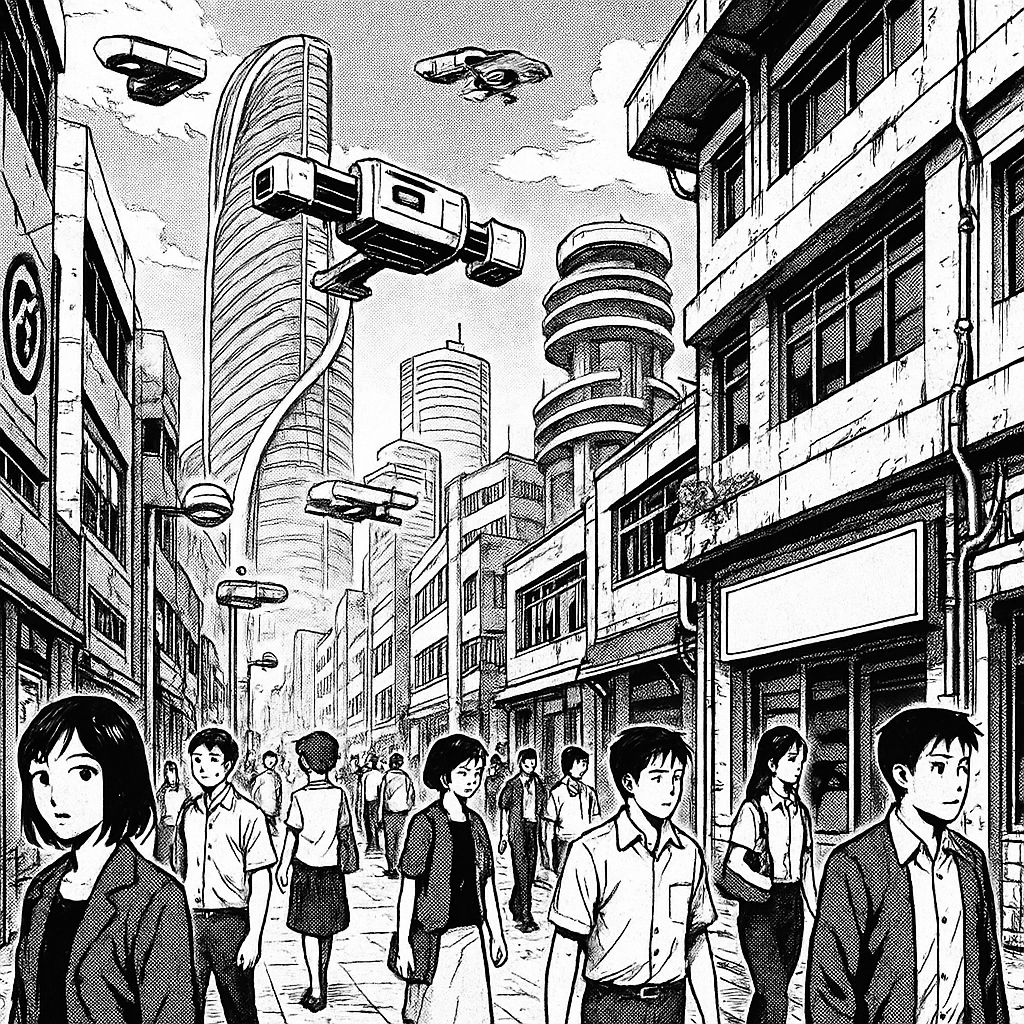
A Novel
Paris Before the Line
On the mornings when the light arrived softly over the Seine, Leonie Moreau believed the world might yet be persuaded.
She lived on the fourth floor of a narrow building in the 11th arrondissement, where the staircase tilted slightly and the banister held the polish of a century of hands. Each day began the same way: the sound of the boulangerie below lifting its shutters, the scent of bread rising through the stairwell, the low mechanical sigh of the metro beneath the pavement – not loud enough to intrude, only enough to remind.
Paris did not press upon her. It accompanied her.
She would step into the street and be absorbed into that particular choreography only Paris had perfected: the exchange of glances at crossings, the choreography of café chairs unfolding toward the sun, the quiet authority of plane trees aligned along boulevards as if they had been thinking for centuries.
Leonie was an urban planner, though she had once intended to be a novelist. She sometimes suspected the professions were not so different. Both involved imagining lives unfolding within structures. Both required an intimacy with streets.
Her work concerned density – a word that frightened many people. Yet when she walked from Bastille to République in the morning, passing markets, schools, offices, and parks within the span of twenty minutes, density felt less like compression and more like kindness. Everything was near. Life was layered rather than scattered.
On those mornings she sometimes wondered, half-seriously, what would happen if the world learned this lesson at scale.
It began, as many dangerous ideas do, as a sketch.
The Drawing of the Square
The year the reports became impossible to ignore – the year the rivers in three continents receded in unison — Leonie was invited to join a commission convened outside Paris. It was described as exploratory, visionary, non-binding. The invitation bore no logo, only coordinates.
The meeting took place in a field beyond the périphérique, where the city frayed into logistics warehouses and remnants of farmland. There were perhaps thirty of them: engineers from Seoul, architects from Lagos, climate scientists from São Paulo, economists, poets, even a desert urbanist from the Gulf whose last project had been a city drawn in a single line across sand.
They stood in a rough circle, the grass bending around their shoes. “We are not here to design a city,” said the chair, an elderly planner with a voice like dry paper. “We are here to ask what would happen if we stopped pretending the earth is infinite.”
Someone laughed softly. Someone else took notes.
It was the desert urbanist who drew the first line. He took a wooden stake and pressed it into the soil. Then another, some metres away. Then another. Soon, a crude square began to emerge – not to scale, of course, but symbolic.
“A city for everyone,” he said. “At the density of Paris.”
There was a murmur – amusement, scepticism, a thrill of absurdity.
They did the arithmetic in the air. Eight billion people. Twenty thousand per square kilometre. Four hundred thousand square kilometres. A square roughly six hundred and thirty kilometres on each side. Finland, but inhabited entirely by humanity.
“It is impossible,” said the engineer from Seoul. “Yes,” Leonie replied. “That’s why it’s useful.”
They called it Concordia before anyone could object.
The Ghosts Who Attended
In the weeks that followed, the commission met again and again, though no government officially acknowledged its existence. They spoke in borrowed lecture halls, in half-lit studios, once in a disused factory where pigeons watched from rafters.
The ghosts of earlier visions attended their conversations.
Le Corbusier hovered at the margins, stern and uncompromising, insisting that sunlight must be distributed equitably, that towers in parks could liberate the ground. Leonie felt both admiration and resistance toward him. She had walked through too many windswept plazas to accept his geometry uncritically. Yet she could not deny the clarity of his ambition.
From Japan came the spirit of the Metabolists – cities as living organisms, capable of growth and renewal. Plug-in structures. Floating districts. The engineer from Seoul sketched infrastructural lattices that could adapt over decades, like bones that thickened under stress.
The desert urbanist spoke of Masdar and of the Line – projects ridiculed and revered in equal measure. “They were prototypes,” he said. “Not conclusions.”
Leonie began to imagine Concordia not as a monument but as a metabolism. A square that breathed.
They imagined great parks, not decorative but continental: thousands of them, each large enough to lose oneself in for a day. Smaller parks threaded through neighbourhoods so that no child would grow up without shade. A lattice of rail lines beneath the surface, so dense that walking would remain primary and distance would rarely intimidate.
Beyond the square, they drew vast swathes of the planet left untouched. Forests uncut. Rivers unchannelled. A rewilded earth encircling a single, improbable urban continent.
It was madness. It was also, Leonie sensed, a mirror.
A City That Would Never Be Built
The media discovered them eventually. “The Finland City,” one headline called it. “The Square That Wants to Swallow the World.”
Leonie was invited onto panels, then accused of technocratic hubris. How would culture survive such compression? What of migration, of sovereignty, of memory? Were they proposing to empty villages, to dissolve languages? She answered carefully. “We are not proposing anything,” she said. “We are asking a question.”
At night, in her apartment above the boulangerie, she would look at the city lights flickering across rooftops and feel the scale of the dream pressing against her ribs.
She knew Concordia would never rise. Humanity was not a fluid to be poured into a geometric container. Cities were sediments of history, not interchangeable units. To gather everyone into one square would be to erase too much.
And yet the arithmetic lingered. Four hundred thousand square kilometres. The rest of the planet freed. Was sprawl inevitable, or simply habitual? Was distance freedom, or an expensive illusion?
One evening, unable to sleep, she walked to the Seine. The river moved steadily under the bridges, indifferent to speculation. Paris glowed around her – not a utopia, but a living, flawed, generous city.
She realised then what Concordia truly was.
Not a blueprint. A reflection square.
It revealed how much land humanity occupied not because it needed to, but because it had never been required to consider the alternative. It illuminated the possibility that density, when shaped with care, could be beautiful. It exposed the extravagance of dispersal.
Concordia would never exist. But its shadow might.
The World After the Square
Years passed. The commission dissolved quietly. Governments pursued more modest reforms. Cities densified here and there. Rewilding projects expanded. Rail networks multiplied. The world did not consolidate into a single square – but it began, in places, to lean closer together.
Leonie remained in Paris.
Each morning, she descended the staircase and stepped into the street, grateful for the proximity of things. She no longer imagined humanity compressed into a vast geometric continent. Instead, she saw the square everywhere: in new housing built above old rail yards, in neighbourhoods redesigned around parks, in the quiet decision of a family to live near work rather than beyond it.
The true Concordia, she understood, was incremental.
It was every act of gathering that allowed the rest of the world to breathe. And sometimes, when the light fell just so across the Seine, she would picture the impossible square stretching far beyond the horizon – not as destiny, but as reminder.
A reminder that the earth is finite. That closeness can be gracious. That geometry, when held lightly, can help us see. The square never held the world.
But for a moment, it held a mirror to it.