Anyone who has spent enough time in architecture, urban planning, development, or local government will recognize the genre immediately: A project team is “excited to announce” that it has been selected to help create a “vibrant mixed-use district” that will become a “dynamic and inclusive destination” while delivering “high-quality housing,” “innovative workplaces,” “lively public spaces,” and a “sustainable future” for one of the country’s “most forward-looking cities.”
The specific location changes. The project changes. The client changes. Yet somehow the language remains almost identical. I know this because I have written some of it myself. Most professionals in our field probably have.
That is what makes the phenomenon interesting. It is easy to ridicule the language of project announcements. It is harder to admit that many of us contribute to it. The same planners and architects who complain privately about buzzwords often produce them publicly. The same developers who criticize generic marketing language often approve it. The same municipal officials who ask for authenticity frequently remove anything that sounds too specific, controversial, or uncertain. The result is a curious form of collective authorship. Nobody particularly likes this language, yet everyone keeps producing it.
Part of the reason is understandable. Urban development is an inherently political activity. Every major project involves a complicated coalition of interests. Municipalities want affordable housing. Developers need financial viability. Residents want quality of life. Investors want certainty. Environmental groups want sustainability. Mobility experts want fewer cars. Heritage advocates want preservation. Politicians want public support.
In such an environment, language gradually evolves toward the lowest common denominator. Every statement must be acceptable to everyone. Every sentence must avoid conflict. Every ambition must sound universally beneficial. The rough edges are removed. The disagreements disappear. The difficult trade-offs remain hidden. Eventually, the project description becomes less a description than a diplomatic document.
The irony is that this process often strips away precisely the things that make projects interesting. Real urban development is fascinating because it is full of tensions. How much density is appropriate? How much affordability can realistically be achieved? What should be preserved and what should change? How should limited public funds be allocated? What kind of city are we trying to build?
These are difficult questions. They are also the questions that citizens actually care about. Yet by the time many project announcements are published, those questions have disappeared beneath layers of reassuring terminology. We are left with districts that are vibrant, communities that are inclusive, places that are connected, futures that are sustainable, and ambitions that are innovative. Every project appears to solve every challenge simultaneously. Every outcome is positive. Every stakeholder is enthusiastic. The language begins to resemble a form of professional political correctness – not in the ideological sense, but in the literal sense of being carefully engineered to avoid saying anything that might provoke disagreement.
The consequence is not merely that the writing becomes dull. The deeper problem is that it becomes less informative. If every project promises vibrancy, then vibrancy no longer means anything. If every neighbourhood is innovative, the word ceases to distinguish one proposal from another. If every city is dynamic and forward-looking, then those terms tell us nothing about the place itself.
Citizens are often accused of not understanding planning and development. Yet we rarely acknowledge how difficult we make it for them. We communicate through a vocabulary that has become largely detached from observable reality. Residents can see buildings, streets, parks, densities, rents, and traffic. What they cannot see is “placemaking,” “future-proofing,” or “innovation ecosystems.”
Perhaps we would be better served by speaking more plainly. Instead of announcing the creation of a vibrant mixed-use district, we could explain what is actually being built. Instead of promising sustainable mobility, we could explain how many parking spaces are planned and what alternatives will be provided. Instead of celebrating affordability in the abstract, we could state how many affordable homes are intended and for whom. Instead of claiming that a project reflects a city’s ambition, we could explain what that ambition actually is. Most importantly, we could acknowledge uncertainty.
Urban development is not a finished product when it is announced. It is a process of negotiation, compromise, learning, and adaptation. Many of the most important decisions have not yet been made. Many challenges remain unresolved. Some aspirations may ultimately prove impossible. That is not a weakness. It is the nature of city-making.
Imagine if project teams occasionally said so. Imagine an announcement that admitted the site was difficult. That affordability targets would be challenging. That higher densities would generate debate. That financial and environmental objectives might conflict. That some decisions remained open. Such communication would undoubtedly be messier. It would also be more credible.
The public is remarkably capable of understanding complexity. What people often distrust is not complexity but excessive certainty. When every project is presented as an unqualified success before it has even begun, skepticism becomes a rational response. Perhaps the real challenge is not creating better cities but describing them more honestly.
The industry does not suffer from a shortage of expertise, ambition, or creativity. What it suffers from, at times, is a shortage of plain language. We have become so accustomed to speaking in the dialect of project brochures and LinkedIn announcements that we occasionally forget how normal people talk. And maybe that is the ultimate irony. We spend our professional lives designing places for people, while increasingly describing those places in language that no actual person would ever use.
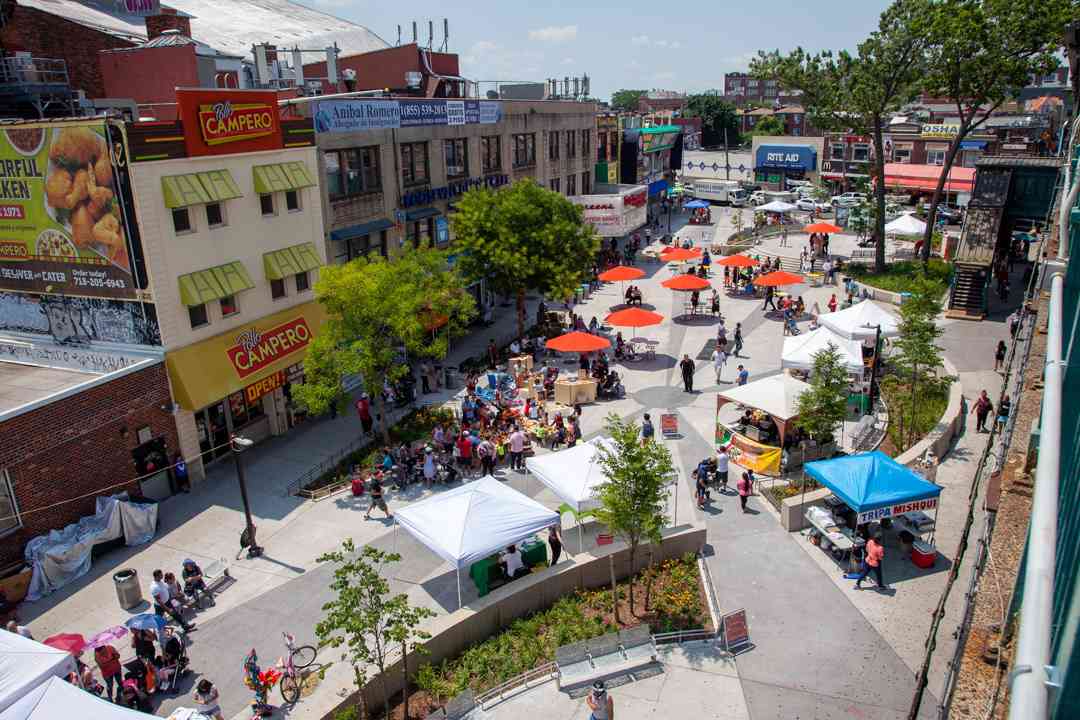
Cover image: Street Lab (Uni Project) under CC license