How drones are redrawing our cities, our industries and our understanding of resilience.
I am in Saudi Arabia’s capital Riyadh and the city feels different today. The drone alerts that punctuated daily life only a short while ago have disappeared, and on the surface the city has returned to normal. Traffic once again fills the highways. Construction cranes continue their relentless work on the Saudi capital’s extraordinary transformation. Restaurants are busy, shopping malls are crowded and people have resumed their routines. Yet beneath this apparent calm something has changed, and it becomes apparent the moment conversations drift toward the conflict unfolding across the region.
The initial tension has given way to something quieter but perhaps more profound. People are no longer reacting to an immediate threat. They are reflecting on what it means to live in a world where war can suddenly enter their skies. Turning on the television no longer feels like watching a distant conflict unfold somewhere beyond the horizon. The drones shown on the evening news recently flew over the same country in which you are standing. Missile interceptions are not abstract military operations but events that briefly altered daily life. Geography suddenly becomes intensely personal.
For many Europeans, despite the terrible destruction in Ukraine, war still remains psychologically distant. It dominates newspaper headlines and political debate, but it rarely interrupts everyday routines. Here in the Middle East that distance disappears. Even when no explosions are heard and no damage is visible, the awareness that conflict can reach your city within minutes fundamentally changes how people think about security, infrastructure and the future.
This difference in perception may ultimately prove to be one of the most significant consequences of contemporary warfare. It forces societies to reconsider not only their military strategies but also the spatial organization of entire nations. The geography of defence is changing, and with it the geography of cities, industries and infrastructure.
Preparing for the wrong war
Throughout history, military planners have often found themselves preparing for the previous conflict rather than the next one. After the First World War came larger tanks. After the Second World War came nuclear deterrence. During the Cold War enormous military-industrial complexes emerged that were capable of producing vast quantities of increasingly sophisticated weapons. Size, quantity and industrial capacity became the defining characteristics of military strength.
Many of those assumptions still shape defence policy today. Across Europe, governments are increasing military spending at levels not seen for decades. Production lines for tanks, fighter aircraft, frigates and conventional ammunition are expanding once again. There is understandable logic behind these decisions, as conventional military capabilities remain essential and large-scale territorial conflict has returned to Europe in ways few anticipated only a decade ago. Yet Ukraine has simultaneously demonstrated that another revolution is taking place, one that may ultimately prove even more transformative than the return of conventional warfare. The defining weapon of the twenty-first century is not necessarily the most expensive platform. Increasingly, it is the fastest evolving one.
Commercial drones costing a few hundred euros have become reconnaissance platforms capable of directing artillery with astonishing precision. Small explosive drones have destroyed tanks worth millions. Autonomous naval drones have forced one of the world’s most powerful fleets to withdraw from areas it once dominated. Long-range drones now strike strategic infrastructure hundreds or even thousands of kilometres behind traditional front lines, reaching places that previously required complex missile systems or highly risky air operations.
Perhaps even more remarkable is the extraordinary speed at which this technology evolves. Innovations appear not every decade but every few weeks. New countermeasures immediately generate new offensive solutions, creating an almost continuous cycle of adaptation. Software updates become as important as hardware. Artificial intelligence increasingly enhances target recognition, autonomous navigation and coordinated swarm behaviour. What worked successfully six months ago may already have become obsolete.
Military procurement, however, still largely operates according to twentieth-century logic. Development programmes frequently require ten or fifteen years before new systems become operational. By the time production reaches scale, the battlefield itself may already have changed.
The lesson emerging from Ukraine is therefore not simply that drones matter. It is that the speed of innovation itself has become a strategic resource.
From arsenals to innovation ecosystems
For more than a century national security was measured by the size of military stockpiles. Nations accumulated enormous quantities of equipment designed to sustain prolonged wars of attrition. Warehouses filled with ammunition, vehicles and spare parts represented strategic insurance against future conflict. That logic begins to weaken when technology evolves faster than inventories can be consumed.
A warehouse filled with thousands of drones may sound reassuring today, but if new guidance systems, improved artificial intelligence or more effective countermeasures emerge within months, large portions of that stock could rapidly lose much of their military value. Instead of accumulating equipment, countries increasingly need the ability to redesign, manufacture and deploy new generations of systems almost immediately.
The strategic asset of the future may therefore not be the warehouse but the innovation ecosystem behind it. Universities, research institutes, software companies, robotics firms, start-ups and advanced manufacturers together become part of national defence. Military capability increasingly depends on the capacity to absorb new ideas, translate them into production and deploy them before opponents do the same.
This represents a profound change in the relationship between defence and the economy. National security no longer depends only on soldiers and weapons but equally on engineers, software developers, industrial designers and entrepreneurs. Innovation becomes deterrence.
Factories that sleep until they are needed
This changing reality also challenges the way industrial production itself is organized: During the twentieth century, dedicated military factories operated continuously, producing equipment that was often stored for years before being used. Maintaining permanent production lines for every conceivable military system is becoming increasingly difficult to justify when technological cycles have become so short.
Instead, we may need an entirely different industrial model: Imagine factories that produce civilian robotics, autonomous vehicles or electronic components during peacetime but can switch within days to manufacturing military drones, communication equipment or autonomous logistics systems. Such dual-use production would allow industrial capacity to remain economically productive while simultaneously providing strategic flexibility.
Alongside these facilities, countries could develop what might be described as sleeping factories. These are production sites that remain largely inactive under normal circumstances, maintained through periodic testing and workforce training but capable of scaling rapidly whenever national emergencies arise. Rather than storing millions of potentially obsolete weapons, nations would store manufacturing capacity itself. The strategic reserve becomes industrial adaptability. Such a model requires new relationships between governments and private industry. Defence policy increasingly becomes industrial policy, innovation policy and education policy simultaneously.
The return of geography
For decades economic globalization encouraged concentration. Production clustered in ever larger factories because scale maximized efficiency. Logistics became increasingly centralized. Supply chains stretched across continents in pursuit of lower costs.
Conflict introduces different priorities: Large centralized facilities are efficient, but they are also highly vulnerable. A single successful strike can disable enormous production capacity. The more valuable a facility becomes, the more attractive it becomes as a target.
Resilience follows the opposite logic: Instead of one massive production complex, future manufacturing networks may consist of hundreds of interconnected facilities distributed across entire regions. Digital production technologies, additive manufacturing and advanced robotics increasingly allow production to be decentralized without sacrificing quality. Factories become networks rather than individual buildings.
This transformation has profound spatial consequences. Industrial estates, transport infrastructure, logistics hubs and energy systems will increasingly be designed not only for efficiency but also for survivability. Redundancy, long dismissed as economically inefficient, may once again become an essential planning principle. Urban planners rarely consider defence when allocating industrial land. They may soon have to.
There are no rear areas anymore
Perhaps the most striking feature of contemporary warfare is the disappearance of the traditional distinction between front lines and rear areas. Throughout much of military history, civilian life continued relatively normally far behind active battlefields. Industrial production, logistics and administration remained protected by geographical distance. The front moved gradually across territory, leaving large parts of countries physically untouched. That geography no longer exists.
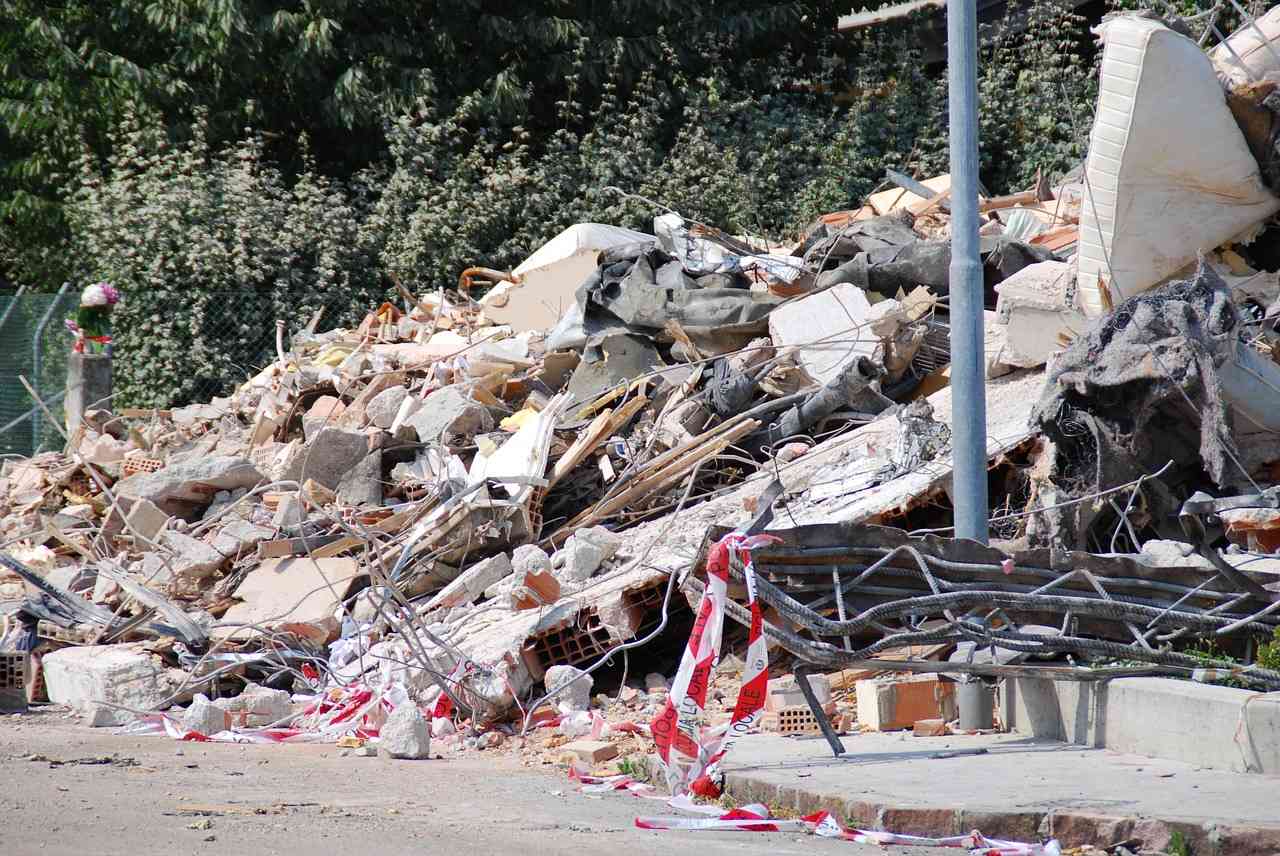
Long-range drones, cyber attacks and precision-guided weapons now allow military operations to reach almost any strategic target regardless of distance. Power stations, airports, ports, communication centres, industrial facilities and logistics hubs have all become potential targets. Entire national territories increasingly function as operational spaces. Cities are therefore no longer merely supporting military operations. They have become integral elements of the battlefield itself. This does not necessarily mean widespread destruction. More often it means vulnerability. It means dependence on systems that can be disrupted without armies ever entering the city. The modern battlefield is invisible until everyday life suddenly stops functioning.
The resilient city
Urban resilience has become a familiar concept during the past decade, largely driven by climate change. Cities prepare for floods, extreme heat, droughts and rising sea levels. Emergency management increasingly focuses on natural hazards whose frequency continues to increase. Those efforts remain indispensable, but the emerging security environment demands that resilience be understood more broadly.
Can electricity continue flowing if major substations are disabled? Can hospitals function independently for extended periods? Can drinking water systems operate without centralized digital control? Can emergency services communicate when mobile networks fail? Can public transport continue operating without satellite navigation? Can financial systems function during prolonged cyber disruptions? These questions are no longer theoretical exercises. They have become urban planning questions.
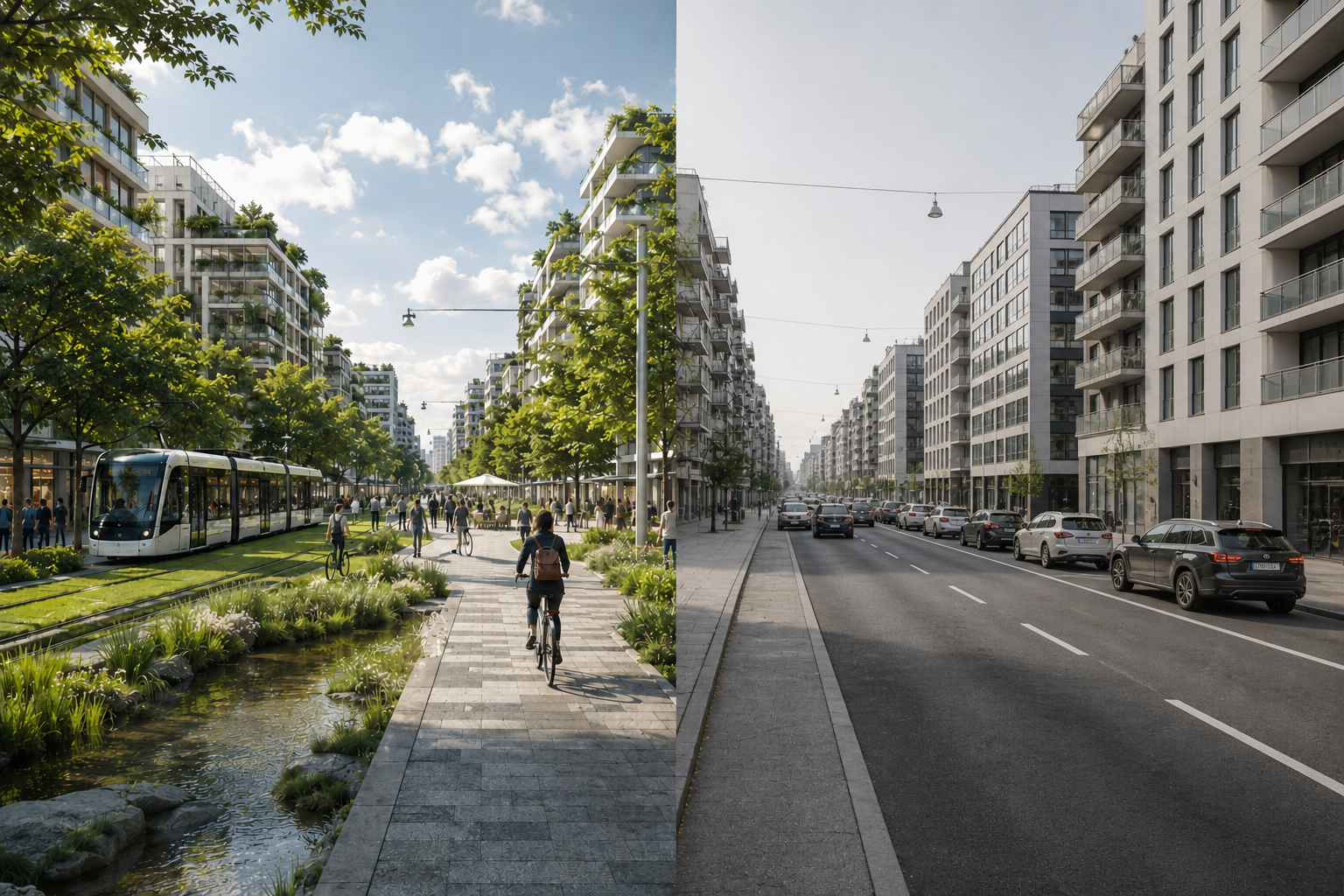
Future infrastructure must increasingly combine efficiency with redundancy. Distributed energy systems, localized water storage, protected data infrastructure and multiple communication pathways all become part of urban design rather than merely technical engineering. Efficiency alone is no longer enough. Cities must also be capable of failure without collapse.
Communication becomes critical infrastructure
One of the less visible lessons emerging from recent conflicts concerns communication. Modern warfare increasingly depends upon information. Drones require navigation. Emergency services require coordination. Governments require trusted channels through which they can communicate with citizens. Society itself increasingly depends upon digital connectivity for almost every aspect of daily life. The loss of communication may therefore prove more disruptive than physical destruction itself.
Future resilience requires communication systems that overlap rather than depend upon a single technology. Satellite communications, terrestrial fibre networks, decentralized mesh systems, emergency radio infrastructure and independent local networks should complement rather than replace one another. The objective is not perfection. It is continuity.
Citizens as part of national infrastructure
Perhaps the most overlooked component of resilience lies not in technology but in society itself. For decades, particularly in affluent societies, governments have become extraordinarily successful at shielding citizens from disruption. Electricity is expected to function continuously. Supermarkets remain stocked. Mobile phones remain connected. Clean drinking water arrives effortlessly through underground pipes. The very success of these systems has made societies increasingly unfamiliar with interruption.
Modern crises repeatedly demonstrate that this assumption is fragile. Pandemics disrupted supply chains. Cyber attacks have temporarily disabled essential services. Extreme weather events have interrupted power supplies across advanced economies. Military conflict introduces another layer of uncertainty. The question therefore becomes uncomfortable but necessary: Could our societies continue functioning if those systems failed for several days?
Do households possess emergency supplies? Do families know where to meet if communication networks collapse? Do schools teach preparedness rather than simply emergency procedures? Can neighbourhoods organize themselves without immediate external assistance? Resilience is ultimately not something governments deliver. It is something societies possess.
A new spatial agenda
These developments fundamentally expand the role of urban planning. Spatial planning can no longer concern itself exclusively with housing, mobility, environmental quality and economic development. It must increasingly integrate questions of national resilience, strategic infrastructure, industrial flexibility and territorial security. This does not mean militarizing cities. It means recognizing that resilience has become a central planning objective alongside sustainability, affordability and quality of life.
Industrial zones must be evaluated not only for economic productivity but also for strategic adaptability. Energy systems must be assessed not only for carbon emissions but also for operational resilience. Digital infrastructure must be planned not only for speed but also for survivability. The distinction between civilian and military planning gradually becomes less absolute because both increasingly rely upon the same physical systems.
Planning for uncertainty
The greatest lesson of contemporary warfare may ultimately have little to do with warfare itself. It teaches us that uncertainty has become permanent. Cities have always adapted to technological revolutions. Railways reshaped nineteenth-century urbanization. Highways transformed the twentieth century. Digital infrastructure redefined the early twenty-first century. Conflict may now become another force reshaping urban geography, not because cities expect war, but because resilience against disruption increasingly benefits society under every circumstance. The same distributed energy systems that improve military resilience also strengthen climate adaptation. Redundant communication systems improve disaster response. Flexible manufacturing supports both economic innovation and national security. Good resilience planning serves multiple futures simultaneously. That may ultimately become the defining characteristic of the next generation of cities.
The twentieth century built military-industrial complexes designed for mass production. The twenty-first century will likely build innovation ecosystems capable of constant adaptation. It will require factories that can change purpose overnight, infrastructure that continues functioning when individual components fail, communication systems that refuse to collapse under pressure and citizens who understand that resilience begins long before a crisis arrives.
The geography of war has changed – the geography of preparedness must now change with it.
Image: wikipedia.org