London is closing Oxford Street to traffic. Other cities should be asking themselves why they haven’t done the same.
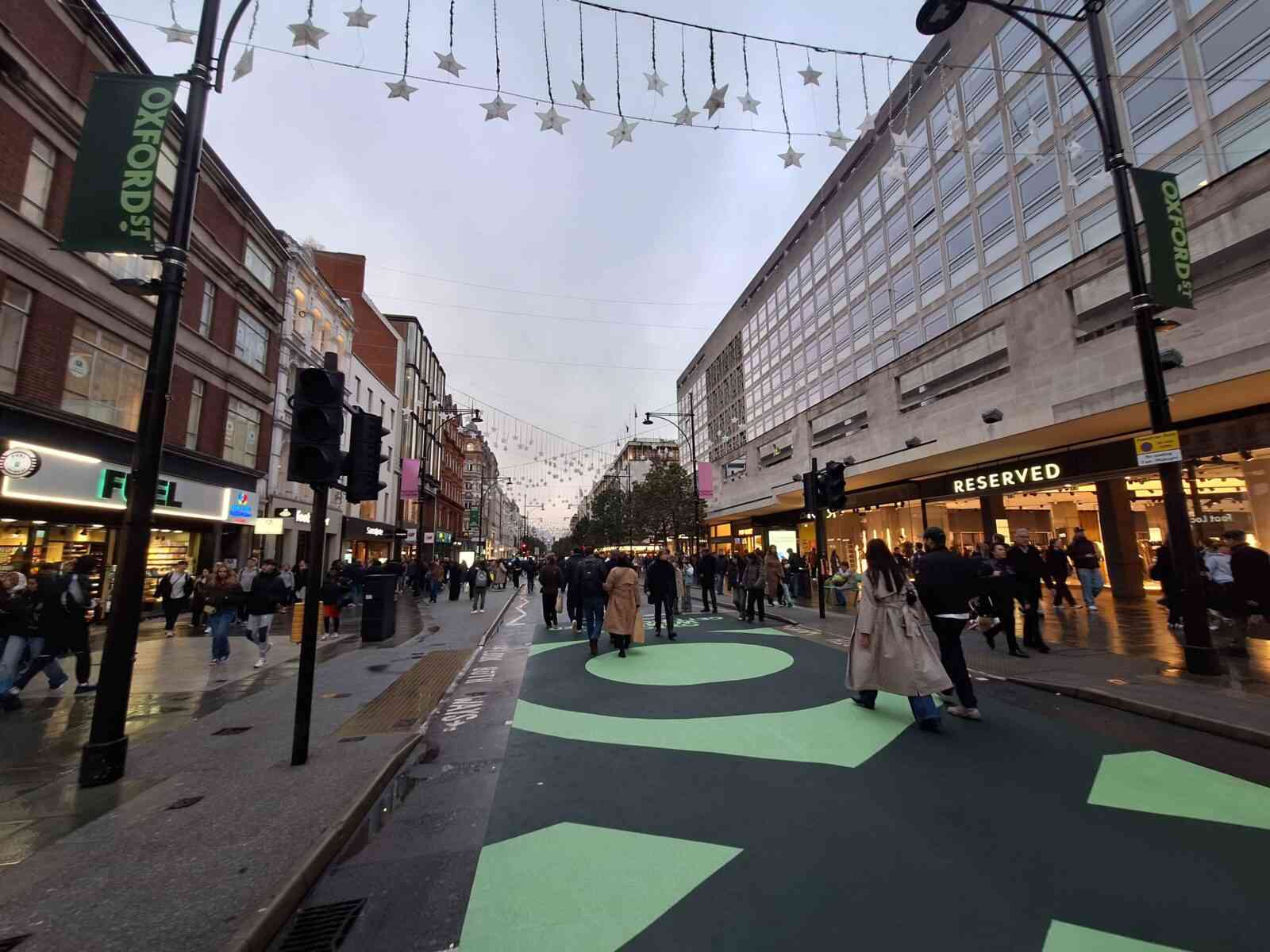
London has finally done it. Oxford Street, or at least a substantial part of it, is being handed over to pedestrians. No cars, no buses, no taxis. Not even cyclists are allowed to ride through.
It took decades of debate, political battles and abandoned plans to reach a conclusion that is almost embarrassingly obvious: why would you run traffic through one of the world’s most famous shopping streets?
And why do so many other cities still do exactly that?
How did these streets become famous?
Oxford Street wasn’t always a shopping street. It started as a road leading west from London, once used to transport prisoners to the Tyburn gallows. Hardly a glamorous beginning. As the city grew, merchants discovered the commercial potential of the route. Shops appeared, later department stores, and eventually the Underground brought customers from all over London.
Something similar happened elsewhere, although the starting points differed. The Champs-Élysées in Paris began as a promenade and ceremonial avenue. Fifth Avenue in New York was once a fashionable residential address. Shanghai’s Nanjing Road grew out of international trade and the city’s rapid commercial expansion.
None of these streets became famous because they were particularly efficient roads.
They became famous because people came there. To shop, to meet, to see and be seen. Commerce followed the crowds, and the crowds attracted more commerce. Over time, the streets themselves became destinations. Their names turned into brands.
Then, somewhere along the way, we decided that cars should occupy most of the space.
A rather expensive misunderstanding
The twentieth century was very good at turning streets into traffic infrastructure. We measured capacity, optimised junctions and tried to squeeze ever more vehicles through the city. Even streets where businesses paid astronomical rents for access to passing pedestrians were treated as traffic corridors.
Think about the absurdity of this. A car passing Selfridges contributes practically nothing to Oxford Street’s commercial success. A pedestrian might stop, look at a window, enter a shop, have lunch, meet a friend or just hang around.
Yet we gave the car the better part of the street.
Somehow, accessibility became confused with the ability to drive somewhere. But being able to reach a place and being able to drive through it are two very different things.
Oxford Street is extraordinarily accessible by public transport. Its economic success has long depended on people arriving, getting out of the transport system and spending time there. The traffic running through it was increasingly an inconvenience, not an asset.
The shopkeepers will survive. They might even thrive.
Of course, whenever pedestrianisation is proposed, the same arguments come up. Customers will disappear. Deliveries will become impossible. Shops will close.
Copenhagen heard all this when it pedestrianised Strøget in 1962. People even argued that Danes weren’t suited to spending time outdoors. Today, the street is one of the city’s great attractions. Shanghai has done it on Nanjing Road. Madrid has removed traffic from much of its historic centre. New York turned parts of Times Square, once an enormous traffic junction, into places where people actually sit.
The economic evidence is encouraging too. Research across 14 Spanish cities found median retail sales in pedestrian areas 33% higher than in non-pedestrian areas. That doesn’t mean removing cars automatically increases sales by a third. But it makes the old argument that shops need traffic passing their doors rather difficult to defend.
And there is another reason why this matters more today than it did twenty years ago:
Online shopping has changed the game. If all I want is a pair of shoes, I can probably find them faster and cheaper online. What I cannot order on Amazon is an afternoon in a lively city street. The café, the unexpected encounter, the street musician, the architecture, the pleasure of watching people. Even the occasional bit of urban chaos. This is what physical shopping streets can offer that the internet cannot. And it is becoming their most important competitive advantage.
Even cyclists might have to accept second place
One detail of London’s plan is worth discussing. Cyclists will not be allowed to ride through the pedestrianised section either.
As someone who believes strongly in cycling as urban transport, I find that rather sensible. A pedestrian street is not simply a road without cars. It should be a place where people can walk without constantly checking whether something is approaching from behind. Where children can run around, where you can suddenly stop to talk to somebody, or cross from one side to the other without much thought.
Bicycles are wonderful for getting around cities. But not every piece of public space has to serve movement. Cyclists can be guests, where the space allows it. In very busy places, they may simply have to walk their bikes. Good parallel cycle routes can do the rest.
Don’t turn the street into a shopping mall
There is one danger in all this enthusiasm for pedestrianisation: Cities sometimes seem to think that removing cars, laying expensive paving stones and putting a few designer benches around is enough. Add some trees, a branded Christmas market and perhaps a giant digital screen, and the job is done.
It isn’t.
A great street needs more than shops. It needs places where you can sit without buying a coffee. Independent businesses that haven’t yet been priced out by international chains. Public toilets. Shade in summer, shelter when it rains. And space for things nobody has planned.
Most importantly, it needs people who aren’t necessarily there to consume. Otherwise, we have simply replaced a traffic corridor with an outdoor shopping mall. A prettier one, perhaps, but not necessarily a better piece of city.
So, who’s next?
Why is Fifth Avenue in New York still full of cars? Why does the Champs-Élysées remain such a major traffic artery? And what about the grand commercial streets of cities like Riyadh, where enormous amounts of public space are still given to vehicles?
Of course, every city is different. Deliveries need organising, emergency access must work, and public transport has to remain convenient. In some places, alternatives will have to be built before cars can disappear. But these are practical problems. Not particularly mysterious ones either. Cities have been solving them for decades. What is harder to understand is why we continue to treat some of our most valuable public spaces primarily as roads.
For more than a century, urban planning has been obsessed with movement. How quickly can we get from A to B? How many vehicles can an intersection handle? How much time can we save?
We have become very good at measuring all that. What we still struggle to measure is the value of staying somewhere. Yet that is precisely what made the world’s great streets famous in the first place. People wanted to be there. They still do.
London’s decision isn’t particularly revolutionary. If anything, it is remarkably late. Oxford Street is finally being redesigned around the activity that made it successful. Other cities should take the hint.
A famous street isn’t famous because people drive through it. It’s famous because people want to be there.
And perhaps, after a hundred years of getting this rather basic distinction wrong, we can start designing our streets accordingly.
AI tools have been used for spelling, grammar and enhancement of expression.
Cover image: wikimedia.org – by Tempaccountforediting – Own work, CC BY-SA 4.0