
Saudi Arabia is building at a pace and scale the world has rarely seen. Across its deserts and coastlines, extraordinary visions rise: NEOM’s The Line, a 170-kilometer-long city of glass; Qiddiya, an entertainment and sports capital larger than some countries; the revival of historic Diriyah; the futuristic Jeddah Central waterfront; and King Salman Park, set to be one of the largest urban parks on the planet. Each of these projects is spectacular, a bold declaration of ambition and wealth. They are meant to signal to the world that the Kingdom is not only diversifying its economy, but also reinventing the very idea of what a city can be.
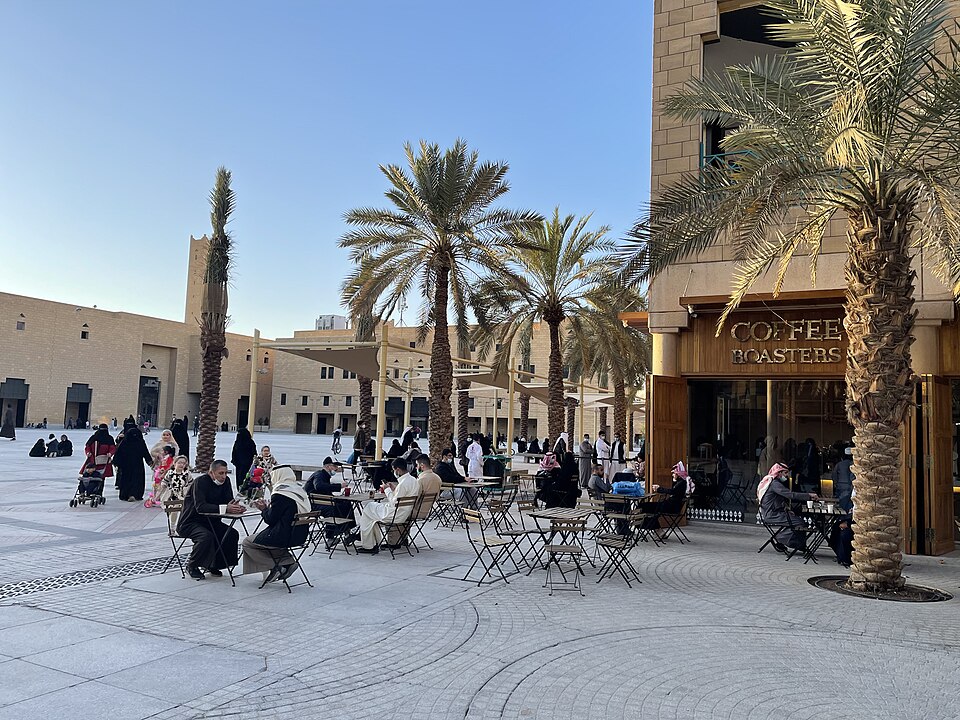
Yet when you put them side by side, a pattern emerges: they are like islands, glittering in isolation. What often gets overlooked is the space in between. Cities aren’t just made of landmarks. They are made of sidewalks shaded by trees, bus rides that connect seamlessly to metro lines, the corner café you pass on the way to work, the public square where neighbours bump into each other, the shaded street you choose to walk because it feels pleasant rather than punishing. Without these connective tissues, even the most dazzling project can feel disconnected, more like a theme park than a living city.
Nowhere is this tension clearer than in Riyadh, a city that has become the stage for multiple giga-projects at once. Alongside King Salman Park, which promises an oasis of green in the desert capital, we find Sports Boulevard, a 135-kilometer-long network of cycling, walking, and horse-riding paths cutting through the city. There is also Riyadh Art, billed as the world’s largest public art initiative, scattering thousands of installations across the urban fabric, and Green Riyadh, a campaign to plant millions of trees to soften the city’s harsh climate. In isolation, each of these projects is impressive. Together, they reveal Riyadh’s ambition to transform itself into a global metropolis, a city capable of hosting events like Expo 2030 and even the 2034 FIFA World Cup.
But will they come together to create a city, or remain as standalone icons? King Salman Park, for example, could become a beloved central lung for the city—but only if Riyadh’s residents can actually get there easily, whether they live in distant suburbs or in dense urban neighbourhoods. The Sports Boulevard might become a transformative piece of infrastructure—but only if it links seamlessly to streets that are safe, shaded, and walkable, rather than becoming a ribbon of privilege disconnected from daily life. Riyadh Art might bring beauty and culture—but art scattered in spaces without people risks turning into decoration rather than experience. Even Green Riyadh’s millions of trees will only succeed if they are planted where people actually walk, wait for buses, or gather, not just in ornamental belts along highways.

This tension—between the spectacular and the everyday, between the project and the connective tissue—echoes across the globe. In Songdo, South Korea, a high-tech “smart city” rose with gleaming towers and a vast central park. Yet, in its early years, it felt eerily empty, because its streets weren’t designed for small encounters, for shops, for children playing, for the messy life of a city. In Masdar City in Abu Dhabi, the futuristic eco-city faltered not because its ambitions were wrong, but because it remained disconnected from the wider metropolis around it.
By contrast, projects like London’s King’s Cross, which began by investing in small-scale public spaces and a fine-grained network of streets, show how regeneration can succeed when the ordinary comes first. Seoul’s Cheonggyecheon stream is another example: tearing down a highway to restore a waterway was not just an environmental project, it was an act of urban stitching, reconnecting districts that had been divided for decades. And Barcelona’s superblocks demonstrate how even a mature city can reinvent itself by focusing not on building more but on connecting better—slowing traffic, prioritizing people, and creating healthier, more sociable neighbourhoods.

What all these examples teach us is that connectivity is not a luxury—it is the essence of urban life. A metro system is only as good as the ease with which people can reach its stations. A park is only valuable if it is embedded in people’s routines, not if it stands as a spectacular but distant attraction. Art matters when it is experienced in the flow of everyday life, not when it is scattered without thought for who will encounter it. The connective tissue—shaded sidewalks, reliable buses, welcoming public spaces—turns projects into places and places into homes.
For Riyadh and Saudi Arabia more broadly, the real mega-project is invisible. It is not a tower, not a park, not a boulevard. It is the city itself—the stitching together of all these bold ideas into a fabric that works for daily life. If the Kingdom can treat this connective tissue with the same seriousness and ambition as it does its iconic landmarks, it may yet succeed in building not just impressive projects but truly great cities. If not, the risk is an archipelago of marvels that dazzle the world but fail the people who live among them.
Cover image: wikimedia.org


