Urban designers have a peculiar habit: we draw the city we would like to have. We draw streets, blocks, parks, buildings and transport lines. We discuss density, mixed use, active ground floors, walkability and public space. Eventually, we produce an image of a future city and implicitly make a rather extraordinary claim: if we can get the spatial configuration right, something resembling that future will emerge.
Except that cities rarely work like that.
Look at almost any major urban transformation today and many of the most powerful forces shaping it are difficult to draw. Interest rates determine whether housing gets built, land ownership determines where, and insurance increasingly determines whether investment continues to flow into places exposed to climate risk. Taxation changes what property owners do with their buildings. Migration changes demand. Digital platforms reorganise retail, mobility and accommodation. Energy prices alter development economics, while regulations determine what can happen long before an architect touches a site.
The drawing comes surprisingly late. Perhaps, then, we have misunderstood the object of urban design. Perhaps our real material is not space, but conditions.
Form is the symptom
This does not mean that spatial design has become irrelevant. Quite the opposite. Streets, buildings and public spaces remain enormously important because this is where urban life happens. But they may not be the primary levers through which cities change.
Consider a new metro station. Its geometry does not transform the surrounding neighbourhood by itself. What transforms the neighbourhood is what the station changes: accessibility increases, land becomes more valuable, investors arrive, development rights become interesting, businesses relocate, residents reconsider where they live, municipalities invest in public space and landlords adjust rents. The physical intervention changes a set of conditions, those conditions trigger thousands of decisions, and those decisions eventually produce another city.
Urban form is what we see; conditions are what make it happen.
This distinction sounds subtle, but its implications are enormous. If the object of urban design is form, then the urban designer’s principal task is to compose space. If the object is conditions, the task becomes something very different: to alter the probability that certain urban outcomes will emerge. That is a less heroic understanding of design, but it may also be much closer to reality.
Cities don’t follow instructions
For more than a century, planning and urban design have struggled with an uncomfortable fact: cities stubbornly refuse to behave like designed objects. They are complex systems involving millions of decisions made by governments, companies, households, investors, communities and individuals, and nobody controls the whole system.
A masterplan may declare that an area will become a mixed neighbourhood, but reality retains a considerable right of reply. The price of capital changes, a government changes, a developer goes bankrupt, migration accelerates, construction costs rise or a new technology transforms commuting. Residents appropriate spaces differently from what designers expected. The city that eventually emerges may bear only a family resemblance to the one that was drawn. This is not necessarily evidence of bad planning. It may instead be evidence that we have been asking planning to do something it cannot do.
Rittel and Webber described planning problems as “wicked” half a century ago. Complexity theory subsequently showed why urban outcomes emerge from interactions rather than commands. Lefebvre and Harvey approached the problem from political economy, arguing in different ways that urban space is produced through social and economic relations rather than simply designed into existence.
Urban design nevertheless remains remarkably attached to its physical object. We have changed our methods and become participatory, strategic, collaborative, resilient and data-driven, yet at the end of the process there is usually still a plan. The more fundamental question is what happens if we change not merely the method, but the object itself.
Urban conditioning
I propose calling this ‘urban conditioning’.
Instead of asking primarily what the city should look like, urban conditioning asks: what conditions would make the city we want more likely to emerge?
These conditions operate across at least six interconnected fields. There are ecological conditions such as climate, water, land, energy and biological limits; institutional conditions including law, property rights, governance, taxation and public finance; and economic conditions such as investment, land markets, housing finance, rent and value capture. Alongside them sit informational conditions—data, platforms, algorithms and the increasingly invisible systems through which cities are organised—as well as socio-cultural conditions such as demographics, trust, household structures, everyday practices and care. Finally, technological conditions encompass mobility, construction, energy and infrastructure.
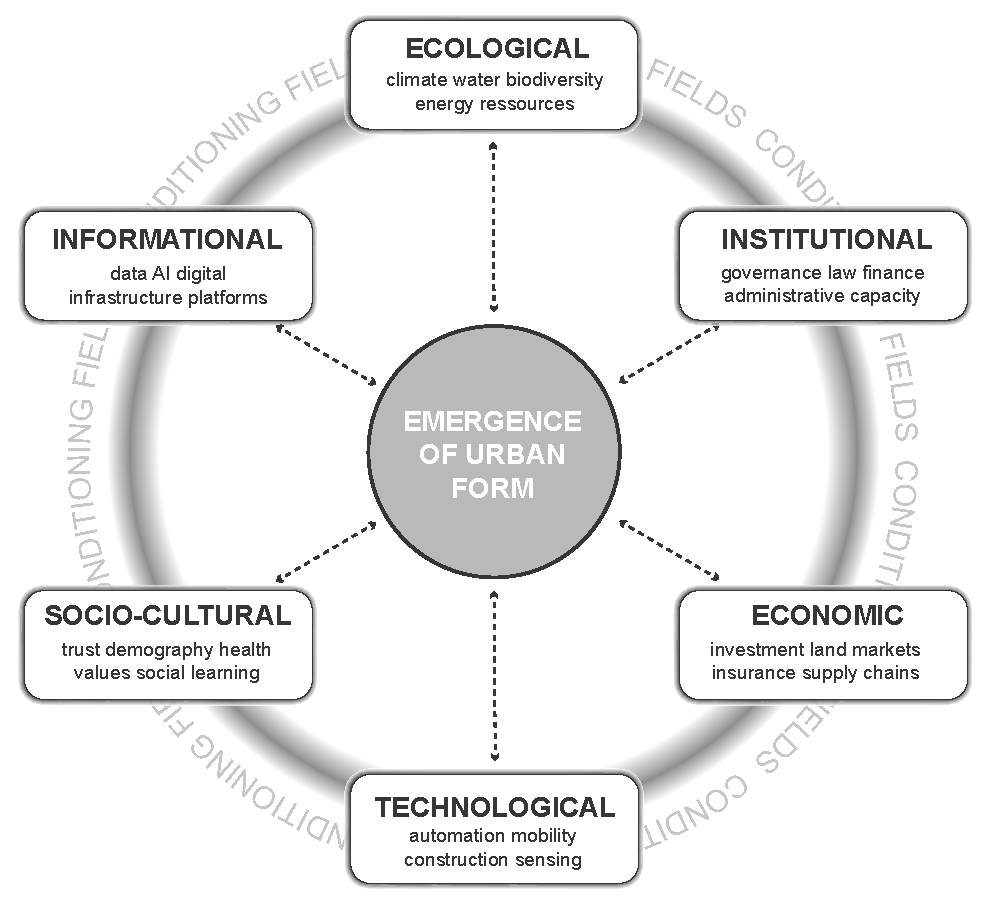
The point is not to create another neat taxonomy of the city. In reality these fields overlap continuously, and no single profession controls them. That may be precisely what makes conditioning interesting as a new object for urbanism.
Take housing
Housing affordability is often presented as a spatial problem. The familiar answers are to build more housing, increase density, allow smaller units, build around transport, convert offices or relax parking requirements. All can help, but consider what actually determines whether someone can afford a home.
Mortgage rates matter. Land prices, tenure law, property taxation, municipal land policy and construction finance matter. Short-term rental platforms, household structures, energy requirements and investor expectations matter too. In such a system, the apartment’s floor plan may be among the least powerful variables.
A conditioning approach therefore asks a different question. Instead of asking what affordable housing we should design, it asks what combination of land, finance, regulation, infrastructure and governance would allow affordable housing to emerge and remain affordable.
Suddenly urban design begins to overlap with economics, law, public administration and political economy. That creates an uncomfortable problem for urban designers, because it challenges the boundaries of their expertise. It also creates an enormous opportunity.
The city has always had many designers
Once we define city-making through conditions rather than form, the boundaries of the profession begin to blur. A transport economist changing a fare structure conditions the city, as does a municipality changing land taxation, an insurer withdrawing coverage from a flood-prone neighbourhood or a platform changing its algorithm. But so does a neighbourhood organisation creating rules for shared space. So do residents maintaining infrastructure where government does not, and informal builders creating housing where formal markets cannot provide it.
This is where the argument connects with a much wider body of urban scholarship. Ananya Roy has argued that informality should not simply be understood as the absence of planning. AbdouMaliq Simone famously described “people as infrastructure”. Feminist urban scholarship has shown how care, maintenance and social reproduction sustain cities even though these activities barely register in conventional accounts of urban development.
Seen through the lens of conditioning, these are not peripheral activities surrounding the “real” work of city-making. They are city-making.
That produces a more radical consequence than simply making urban design more inclusive: it changes who qualifies as an urbanist. A field organised around spatial composition inevitably privileges those professionally trained to compose space. A field organised around conditions has no such obvious boundary, because conditions are already being shaped by governments and investors, communities and informal actors, engineers and activists, residents and platforms.
Rotterdam and Shenzhen: two ways of conditioning a city
Consider two cities that could hardly appear more different. Rotterdam is an old European port city that accumulated its institutions over centuries; Shenzhen is one of the most dramatic experiments in deliberate urbanisation in modern history. Yet both make more sense through their conditions than through their plans.
Rotterdam is rightly celebrated for architecture and urban design, but its development depended on something deeper: an expanding port economy, municipal influence over land, extraordinary water-management institutions and strong public investment. These conditions created the possibility within which much of Rotterdam’s architecture and urbanism emerged.
They also produced winners and losers. Post-war labour migration supplied the workforce on which the economy depended, while later regeneration policies deliberately attempted to change the social composition of poorer neighbourhoods. The so-called Rotterdam Act went further by allowing authorities to restrict some low-income newcomers from settling in designated areas. This too is urban conditioning; it simply reveals its political side.
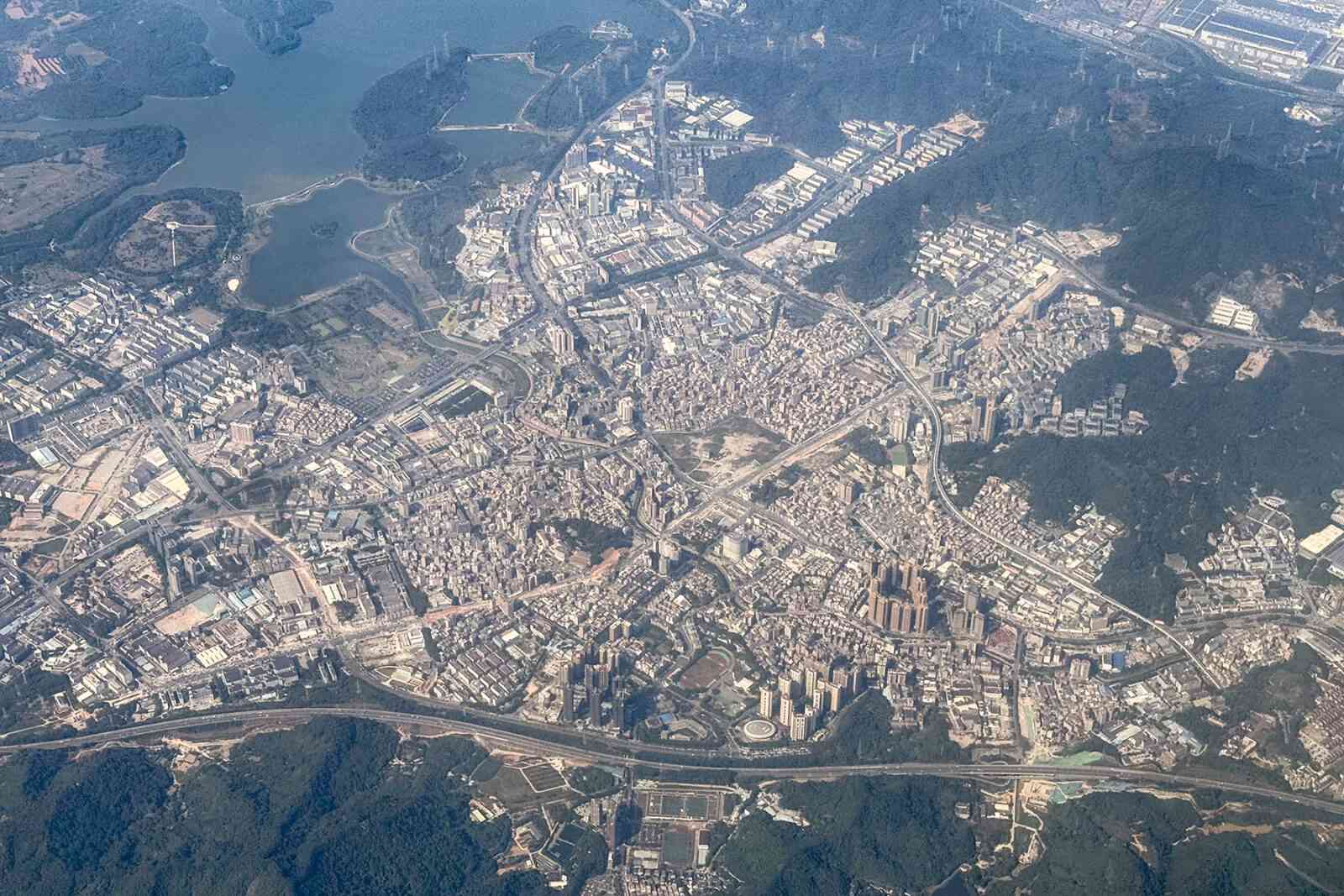
Shenzhen offers the opposite experiment. In 1980, China did not primarily design a new metropolis next to Hong Kong. It changed the rules. Special economic status opened the territory to foreign investment and market experimentation, land could be converted, capital could flow and migrant labour could arrive. Those conditions produced one of the fastest episodes of urbanisation in human history.
Again, however, those conditions distributed opportunity unevenly. Millions of migrant workers helped construct and operate the new city while the hukou system restricted their access to welfare and formal housing. Urban villages emerged to provide what the official system could not: affordable accommodation, social networks and economic opportunity. They became extraordinarily effective pieces of urban infrastructure, yet because they did not resemble conventional planning they were frequently labelled disorderly and targeted for redevelopment.
Rotterdam and Shenzhen therefore tell essentially the same story from opposite directions. Conditions generate urban possibility, but conditions also distribute power.
Whose conditions?
This is where urban conditioning stops being a technical theory. Conditions are never neutral. Change mortgage rules and someone benefits. Change zoning and someone’s land becomes more valuable. Build a railway and some locations become central while others become peripheral. Introduce a climate-risk model and some neighbourhoods become difficult to insure. Create an algorithm and some businesses become visible while others disappear.
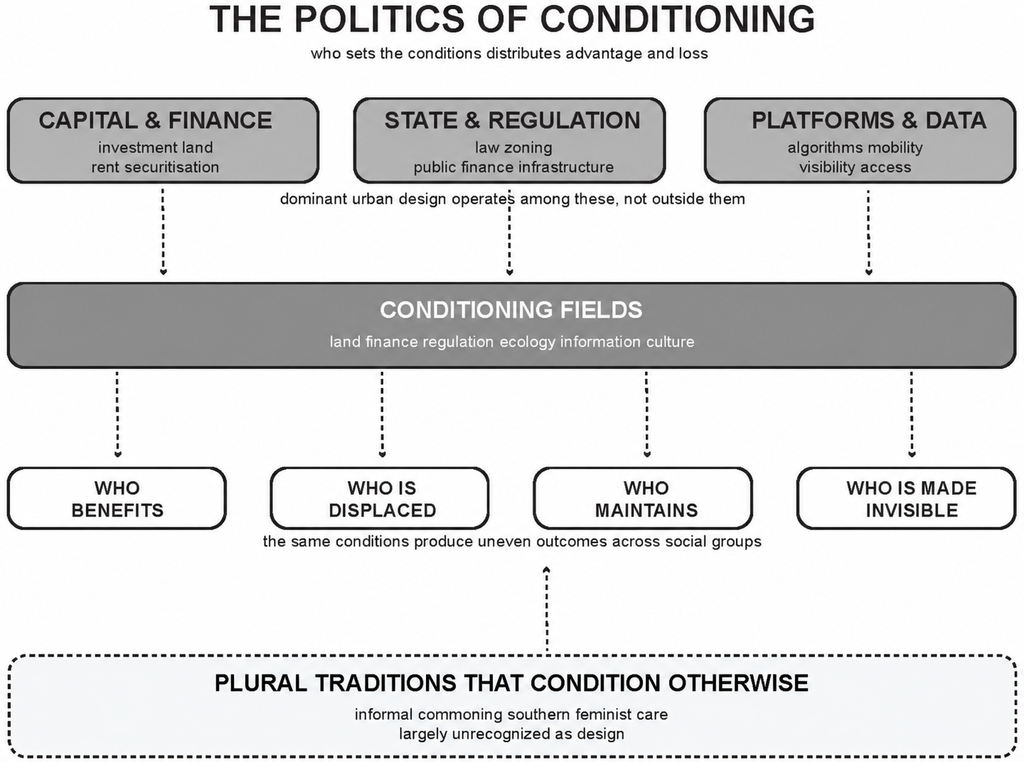
Every act of conditioning distributes benefits, risks and opportunities. The important question is therefore not simply how we should condition cities, but who gets to set the conditions.
That question takes us back to Lefebvre’s right to the city, but perhaps with a slightly different interpretation for the twenty-first century. The right to the city might be understood not only as the right to access and inhabit urban space, but as the right to participate in setting the conditions from which urban life emerges.
This also makes participation a more demanding concept. Inviting residents to comment on the design of a square after the land value, development model, programme, budget and ownership structure have already been determined gives them influence over the visible outcome while excluding them from many of the conditions that produced it. Participation in a conditioning framework would have to begin further upstream.
An urbanism of probabilities
Taking conditions seriously also requires giving up one of design culture’s most persistent fantasies: certainty. Conditioning does not promise outcomes; it changes probabilities.
A new zoning rule may increase the probability of housing construction. A land-value mechanism may increase the probability that infrastructure investment benefits the public. A cooperative ownership model may increase the probability that affordable housing remains affordable, while better water management may increase the probability that a neighbourhood can survive future climate extremes. None guarantees success because the eventual outcome continues to depend on countless interacting actors and processes.
The urbanist therefore becomes less like the author of a finished composition and more like someone continuously adjusting a complex system: reading its conditions, intervening, observing what emerges, learning from the difference between intention and result, and adjusting again. The process has no final state because the city itself has no final state.
That may sound less impressive than unveiling a masterplan, but it could be considerably more powerful.
What this would do to urban design
Taking conditioning seriously would profoundly change the discipline. Urban-design education could no longer revolve predominantly around spatial composition. Students would need to understand land economics, political economy, governance, ecology, regulation, data and social systems alongside morphology and design.
Research would shift too. Instead of asking only whether particular spatial forms produce particular behaviours, we could study configurations of conditions: which combinations of tenure, finance, regulation, infrastructure and social organisation generate particular urban outcomes, how these combinations change over time, and how their benefits and harms are distributed.
Professional practice would consequently become more porous. Economists, ecologists, lawyers, engineers, data scientists, community organisers and residents would not merely become “stakeholders” whom designers consult. They would become fellow conditioners.
This is particularly important because it offers another way of dealing with the long-standing Eurocentrism of urban design. For decades, the discipline has tried to expand its canon by admitting more cities, practices and perspectives. But perhaps the problem is not simply who is admitted; perhaps the problem is the door itself.
A discipline centred on spatial composition inevitably privileges those professionally trained to compose space. A field centred on conditioning has a much lower barrier to entry because cities have always been conditioned through many forms of knowledge and practice. Informal, Southern, feminist, indigenous and community practices do not therefore need to be generously incorporated into such a field. They were already there; we simply failed to recognise them.
Beyond the masterplan
None of this means we should stop designing streets, neighbourhoods or buildings. Cities still need form, and beauty, spatial experience and architecture continue to matter enormously. But perhaps we should become more precise about what design can actually do.
The twentieth-century urbanist often attempted to design the city. The twenty-first-century urbanist may have a different task: to create the conditions under which better cities have a greater chance of emerging.
This is simultaneously a more modest and a more ambitious proposition. It is more modest because it accepts that no designer controls the city, and more ambitious because it expands the territory of urbanism far beyond the things we can draw.
For a discipline that has spent more than a century asking how better spaces might make better cities, the next questions may therefore be more difficult ones: Whose conditions produce the city? Who benefits from them? And who gets to set them?
That may be where the next urban-design debate needs to begin.
AI tools have been used for spelling, grammar and enhancement of expression.
This is an edited version of a paper with the same title.
Cover image: Shiyan, Shenzhen, wikimedia.org