Europe’s defence debate has plenty to say about what we are prepared to spend. A public pool in Helsinki asks a better question. What kind of life are we preparing to defend?
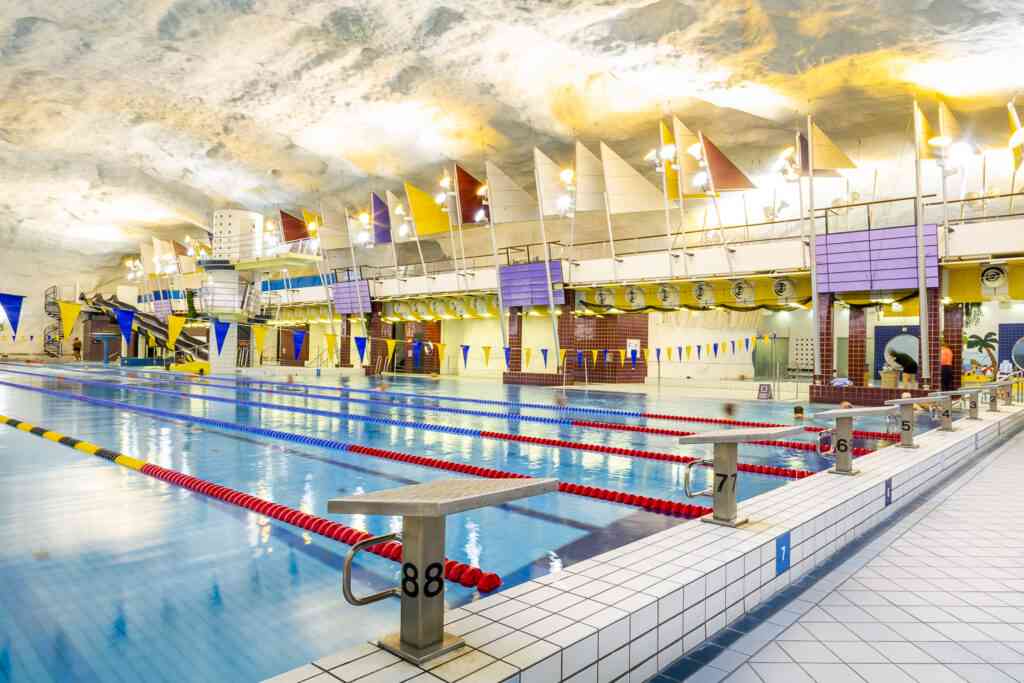
If you want to explain civil defence to a child in Helsinki, one option is to take them swimming. The pool at Itäkeskus, in the east of the city, was built into the rock and opened in 1993. It is also a civil defence shelter. A child can spend years going there, graduate from the shallow end, acquire a tolerable backstroke and remain gloriously uninterested in the building’s other purpose. I find that an unusually convincing return on an investment in security.
Architects tend to have a difficult relationship with bunkers. An entire profession trained to care about façades has to contend with a building whose success can depend on its disappearance. At Itäkeskus, the architecture disappears underground and the public institution carries on quite happily. People know where the entrance is. The rooms belong to their mental map of the neighbourhood. In an emergency, they would be going somewhere they already know. Even if that day never comes, somebody has learned to swim.
What interests me is what would happen if we took this way of thinking above ground.
Much of the debate about European security moves in two familiar directions. One brings the military into civilian life. Ports acquire strategic significance, roads are assessed for military transport, and citizens are asked to prepare themselves. The other brings civilian uses onto military land. The Netherlands offers a curious example. More than 15,000 hectares of Dutch defence land form part of Natura 2000. Some of the country’s dry heath and shifting sands survive on terrain managed for military purposes. On the Leusderheide, a military training landscape even has an ecoduct connecting habitats across the A28. A fence, generally a rather discouraging piece of urban design, can look quite different from the point of view of a lizard.
It would be easy to draw the wrong conclusion and declare military activity good for nature, or add a public running track to a defence project and declare the two budgets reconciled. The more interesting possibility is to change who gets to write the brief. Imagine the municipality, the water utility, the health service, local residents and civil defence sitting down together before anyone has decided what to build. They might discover that the most valuable investment available to them is the refurbishment of something they already own.
I would start with a civilian field manual. Its first page would be a drawing of the neighbourhood as it exists. Who has a kitchen that can cook for two hundred? Which building stays cool in August? Where can someone using a wheelchair get in, use the toilet and spend the night? Who holds the keys on a Sunday? These questions borrow a good habit from preppers, who tend to have a fairly precise idea of what is in the cupboard. At the scale of a city, the cupboard gets more interesting. It contains school canteens, sports clubs, delivery vans, allotments and people who know how to mend things. The essential move is from What do I need to buy? to What do we already have, and under what circumstances could somebody else use it?
That last part tends to get lost. A school kitchen may be equipped to feed a neighbourhood and still be quite useless on a Sunday if the catering contract forbids anyone else to enter. A city can buy a generator in an afternoon and spend six months deciding which department pays to maintain it. This is what systems thinking looks like once the boxes and arrows have been cleared off the screen. Sometimes the missing piece of infrastructure is a clause in a contract. Sometimes it is a second set of keys.
There are good reasons to organise some things centrally. A small municipality can hardly maintain its own specialist emergency hospital. A national government is well placed to set standards, redistribute money and make sure that a poor district can offer the same protection as a prosperous one. It is considerably less well placed to know who can open the sports hall tonight. The sensible division of labour follows the scale of the question. Pool the expensive capabilities. Give people close to the problem the authority and resources to act. And pay the caretaker. The caretaker features surprisingly rarely in national security strategy.
How much of this is really about war? A city hit by a flood and a city hit by a missile may face some of the same problems by morning. People need clean water, a place to sleep, news of their families and some idea of what tomorrow will bring. War can itself be an environmental catastrophe. A damaged industrial site can leave a river polluted long after the reason for the fighting has disappeared from the news. For the town downstream, the distinction between wartime destruction and industrial pollution grows less useful with every year that passes.
Yet war has a quality that a flood does not. Somebody is trying to make somebody else yield. A river has no opinion about the government and no interest in whether the people who fled ever come home. An adversary does. That intention changes what it means to rebuild, whom people trust and whether going home feels possible. It also explains why counting the dead, necessary as it is, settles so little. A death on a dangerous road can devastate a family just as completely. We have nevertheless learned to discuss road deaths in the language of acceptable risk and military deaths in the language of sacrifice. One wonders what our streets would look like if a preventable traffic death commanded even a fraction of the political attention we give to a threat from abroad.
The reverse is worth asking too. What happens when the language of war spreads into every corner of public life? A military commander has good reason to ask who the enemy is and where they are. It is a poor opening question for a neighbourhood meeting. In a heatwave there may be an absentee landlord, a badly insulated roof and a tenant who cannot afford to cool the flat. Finding out who can fix the roof will get us further than finding an enemy. A civilian institution needs the freedom to see a problem in civilian terms, particularly when security money is on the table.
This matters because a rise in defence expenditure tells us very little, by itself, about a city’s ability to cope. A country may have excellent reasons to buy air defence. The purchase can serve its intended purpose admirably while the last public building in a village closes for lack of an operating budget. Both decisions can look entirely rational from inside their respective ministries. From the village, the arithmetic looks different. It has acquired a share in a national capability and lost the only room large enough to hold a public meeting.
Perhaps the Helsinki pool offers the beginnings of a different relationship between the military and the civilian. Its everyday use gives the city a reason to keep the place staffed, maintained and familiar. Its protective purpose gives the city another reason to keep it public. Each commitment makes the other easier to honour. That is a more demanding ambition than asking every architect to draw a thicker wall. It requires the people who commission a building to care what happens there for the next thirty years.
And it offers a fairly precise answer to the question of what we are defending. Somewhere in east Helsinki, a child is probably negotiating the last few metres of a first full length. For the moment, the most pressing question in the building is whether the far wall is quite as far away as it looks. An extraordinary amount of public effort goes into making a moment that ordinary possible. I can think of few better reasons for the effort.
AI tools have been used for spelling, grammar and enhancement of expression.
Cover image: Itäkeskus public swimming pool – Picture: Maarit Hohteri under Creative Commons BY 4.0 license