When ArchDaily published “What Is Metamodern Architecture? Between Postmodern Irony and a New Sincerity” on 24 July 2025, it offered an elegant reading of contemporary architecture. Drawing on the work of Timotheus Vermeulen and Robin van den Akker, the article argues that we have entered a metamodern condition – a culture oscillating between postmodern irony and renewed sincerity, between scepticism and belief, between deconstruction and reconstruction. It is a thoughtful essay, and as a diagnosis of a broader cultural mood it is difficult to disagree with.
What I find less convincing is the underlying assumption that architecture is still primarily driven by theory.
The article suggests that, just as modernism gave way to postmodernism, we are now entering another intellectual paradigm that will shape the production of architecture. But perhaps the defining shift of the past fifteen years is precisely that architecture no longer operates that way. We continue to invent new labels, new “-isms” and new philosophical lenses through which to interpret architecture, but increasingly they explain architecture after the fact rather than determining it beforehand. Theory has become commentary rather than instruction.
The real organising principle of contemporary architecture is no longer ideology. It is economic logic.
That statement is easily misunderstood. Economic logic is not simply about maximising profit. It is far more sophisticated than that. It is the continuous negotiation between financial viability, planning regulations, environmental performance, political ambitions, branding, marketing value, investor confidence, public acceptance, operational efficiency, media visibility and increasingly ESG credentials. Every project represents a series of trade-offs between actors with different interests and different definitions of value. Success lies not in satisfying one objective, but in satisfying enough of them simultaneously.
Architectural ideas survive because they perform within this complex ecosystem. Not because they are philosophically coherent.
That changes everything.
Under modernism, architecture was expected to express a worldview. Under postmodernism, it questioned the possibility of such a worldview. Today, architecture is rarely asked to defend either. Instead, it is expected to combine as many desirable qualities as possible into one convincing proposition. Sustainability, heritage, biodiversity, computational design, local identity, participation, circularity, health, innovation and beauty no longer compete for dominance. They accumulate. Every additional layer strengthens the narrative, increases legitimacy and broadens the project’s appeal.
Anything goes – provided it performs.
This is where I think the metamodern argument begins to lose its explanatory power. It still assumes that architecture evolves through intellectual paradigms. As if one theory quietly replaces another before shaping a generation of buildings. That may once have been true. Today it feels almost nostalgic.
Look at almost any contemporary project and the boundaries have dissolved. A luxury residential tower is wrapped in the language of ecological restoration. Artificial intelligence is celebrated alongside handcrafted craftsmanship. Indigenous knowledge informs digitally fabricated façades. Commercial developments become social infrastructure. Historical references coexist with futuristic geometries. Social inclusion becomes part of luxury branding. None of these combinations feels particularly controversial anymore because none of them is expected to be internally consistent. The project simply needs to tell a compelling story.
Architecture has not entered a new theoretical era. It has entered an era of compatibility.
Every language can coexist with every other language because their role has fundamentally changed. They no longer function as ideologies. They function as assets.
There is another irony hidden in this transformation. Throughout most of its history, architecture has rarely been intellectually in the lead. Architectural theories generally followed broader philosophical developments rather than initiating them. Modernism reflected Enlightenment rationalism and industrial progress. Postmodernism absorbed the linguistic turn and the scepticism towards grand narratives articulated by thinkers such as Jean-François Lyotard. Deconstructivism translated ideas developed by Jacques Derrida into architectural form. Architecture was extraordinarily successful at spatialising philosophy, but it was seldom the discipline setting the intellectual agenda.
This time may be different: Almost unconsciously, and without ever declaring it as a movement, architecture may have become the real avant-garde of the AI age.
While philosophers were still trying to understand digital culture and artificial intelligence remained largely confined to computer science laboratories, architecture had already abandoned singular theoretical systems in favour of recombination. Projects increasingly became exercises in connecting disparate references, values, aesthetics, technologies and narratives into convincing wholes. The discipline quietly shifted from deduction to association, from defending coherent worldviews to assembling plausible constellations of ideas.
Long before large language models connected words through probabilities, architects were connecting concepts through remarkably similar mechanisms. Seen from that perspective, AI is not the beginning of a new architectural epoch. It merely reveals the logic under which architecture has already been operating.
Large language models do not reason from first principles. They recognise patterns across enormous amounts of information and connect fragments through probability. Their remarkable ability lies not in defending a coherent philosophy, but in assembling seemingly unrelated pieces of knowledge into responses that feel meaningful. Their intelligence is associative rather than deductive.
Increasingly, this is also how architecture is produced: Projects assemble behavioural science, ecology, neuroscience, local traditions, digital technologies, material innovation, heritage, participation and social narratives into persuasive wholes. Their success depends less on philosophical consistency than on whether enough stakeholders recognise something valuable in the combination. Investors see reduced risk. Municipalities see climate adaptation. Citizens see public space. Marketing teams see identity. Architects see conceptual richness. Everyone finds their own story reflected in the same building.
In hindsight, architecture did not simply adopt the logic of artificial intelligence. It rehearsed it.
This is neither entirely good nor entirely bad. The great architectural ideologies of the twentieth century produced extraordinary buildings, but they also produced extraordinary blind spots. They often struggled with complexity because they demanded consistency above all else. Contemporary architecture is undoubtedly more adaptive. It borrows freely. It is less dogmatic. It is capable of bringing together ideas that previous generations would have considered fundamentally incompatible.
But there is also a cost: When everything becomes compatible, almost nothing remains capable of resisting. Contradictions stop being problems and become selling points. Every project can be justified because there is always another narrative that makes the combination appear meaningful. Theory itself becomes another ingredient in the marketing package. The danger is not that architecture loses creativity. The danger is that it loses the ability to distinguish between combinations that genuinely improve the world and those that merely improve the presentation. If every story is potentially true, then no story has the authority to guide us anymore.
That is why I believe the future of architecture lies neither in another theory nor in better algorithms – it lies in judgement.
Ironically, this is also where architectural education has become slightly misaligned with the realities of practice. Schools still devote enormous energy to teaching students how to generate ideas, develop concepts and master increasingly sophisticated tools. Yet AI is rapidly making the generation of alternatives almost effortless. Within a few years every student will have access to thousands of credible design options before even drawing the first line.
Generation is becoming abundant – judgement remains scarce.
Architectural education should therefore shift its centre of gravity. Less emphasis on producing another concept, another form or another narrative, and far more attention to developing the capacity to evaluate, reject and choose. The architect’s value will increasingly lie in understanding why one option deserves to exist while ninety-nine others should not. That requires cultural literacy, ethical awareness, historical understanding, political sensitivity and an ability to navigate competing interests without collapsing into either relativism or dogma. It requires the confidence to say no, even when every option appears equally plausible.
Perhaps that is the real project for architecture after theory. Not finding the next “-ism.” Not resisting artificial intelligence. But educating architects whose greatest skill is neither designing nor prompting, but choosing wisely in a world where almost every combination has become possible.
There is a final paradox in all of this. For more than a century, architecture looked to philosophy to explain the age it was living in. This time, it may have arrived there first. Without quite realising it, architecture rehearsed the epistemology of artificial intelligence before artificial intelligence became part of everyday life. It moved from certainty to probability, from ideology to compatibility, from coherent doctrines to the assembly of plausible worlds.
That is why I believe we are witnessing the last architectural theory. Not because theory has disappeared, but because no single theory will again organise the discipline as modernism, postmodernism or deconstructivism once did. The next chapter will not be defined by another -ism. It will be defined by something far less spectacular, but ultimately far more important: judgement.
If AI can generate almost every possible building, the architect’s responsibility is no longer to imagine more possibilities. It is to understand which possibilities deserve to become reality. In a world where everything can be connected, choosing wisely becomes architecture’s highest intellectual act. Perhaps that, rather than another manifesto, is the only architectural theory we still need.
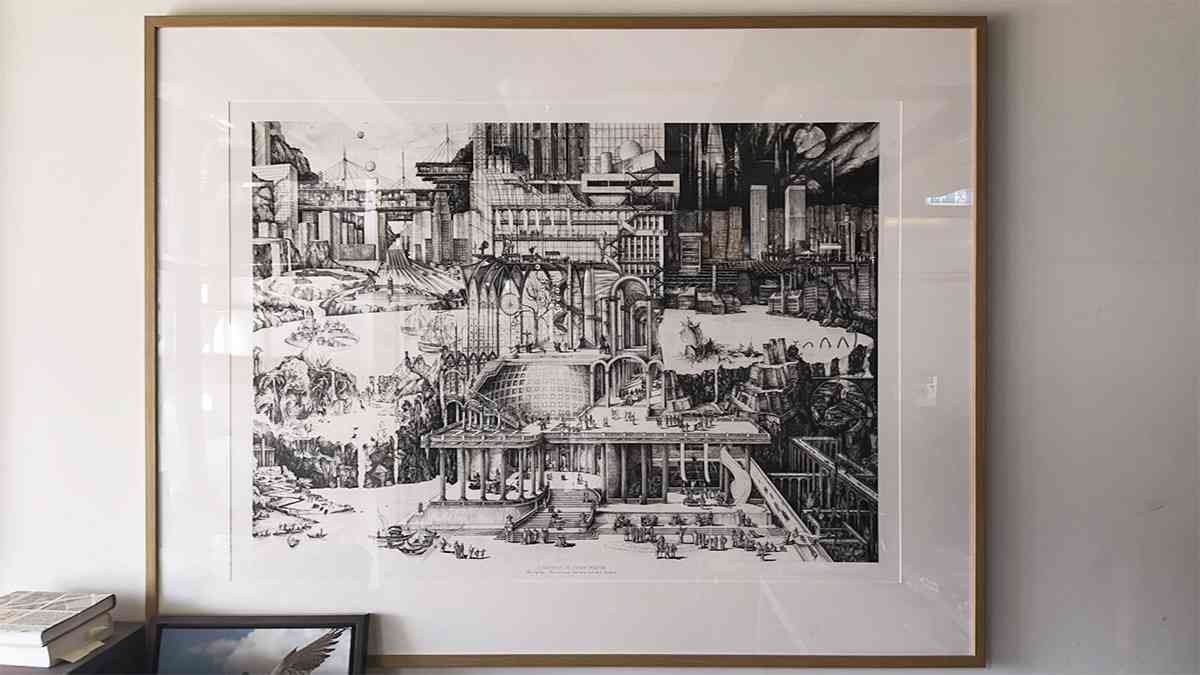
Cover Image: Carlijn Kingma: A history of the Utopian Tradition – hanging in the author’s office
AI tools have been used to edit the essay for spelling, grammar and improved expressions.