The giga-project created the island. The next challenge is making the archipelago work.
For the past decade, Saudi Arabia’s transformation has been represented by objects: NEOM, The Line, Qiddiya, Diriyah, the Red Sea, New Murabba. They were deliberately extraordinary—huge, highly controlled developments intended not merely to accommodate economic change but to manufacture it. Build the destination, infrastructure, company, regulatory environment and often the market simultaneously, with the state absorbing much of the initial risk. Economic activity would follow.
That era is not ending. But something important has changed.
In its 2026–2030 strategy, the Public Investment Fund describes a shift “from growth to realization”. More significantly, PIF says it is moving from being the primary engine of growth towards becoming the “architect and steward of platforms that enable others to scale.” Capital allocation is becoming more selective and private-sector participation more important. PIF describes the transition as moving “from public-led build to private-led growth.” (PIF, 2026)
That sounds like investment terminology. It could actually signal a profound change in the spatial development of Saudi Arabia.
From projects to platforms
The first phase of Vision 2030 needed visible interventions. Saudi Arabia wanted to create industries that barely existed. Waiting for markets to discover them would have taken decades, so government created markets by building their first customers, infrastructure, destinations and companies itself.
Spatially, this produced something very particular: closed development systems. A giga-project could contain its own land, infrastructure, developer, utilities, governance mechanisms and economic programme. The advantage was speed and control. The disadvantage was that every project risked having to create the entire city-making machine again.
The new strategy points towards a different model. PIF describes ecosystems as “platforms for coordinated value creation”, bringing together development, operations, services, technology and supply chains. Public capital establishes scale and reduces initial risk so that private investors can subsequently expand the market.
The spatial question therefore changes. Instead of asking where the next megaproject should go, Saudi Arabia increasingly has to ask how thousands of investments can reinforce one another across its territory.
From islands to networks
A project has a boundary. An ecosystem does not. Tourism depends on airports, landscapes, hotels, workers, water and nearby cities. Manufacturing depends on ports, power, universities, suppliers and housing. AI depends on data centres, electricity, fibre networks and skilled workers.
The next generation of Saudi development could therefore be less about isolated destinations and more about corridors, clusters, metropolitan regions and networks between existing cities. A railway becomes valuable because it expands labour markets. A university supports regional economic clusters. Renewable energy enables industry, water production and data infrastructure across a wider territory.
Existing cities consequently become much more important. Private investors generally prefer functioning markets with customers, workers, infrastructure, suppliers, schools and transport connections. Riyadh, Jeddah, Dammam, Makkah and Madinah are not simply urban areas requiring improvement; they are economic infrastructure. The same applies to smaller cities connected to industrial clusters, universities or logistics corridors.
But this creates another problem: what happens outside the PIF ecosystem?
The danger of a two-speed Saudi Arabia
PIF projects can move quickly because they concentrate political authority, financing, international expertise and specialist delivery capacity. Problems that might take years through conventional institutional channels can often be escalated and solved.
Most Saudi development does not work like that. Thousands of projects will continue through municipalities, ministries, regional authorities and private developers. Existing neighbourhoods need regeneration, smaller cities need to grow and infrastructure needs upgrading. None can realistically have its own giga-project delivery organisation.
Saudi Arabia therefore risks creating a two-speed spatial system: one capable of delivering exceptional projects at exceptional speed, and another where ordinary development remains constrained by fragmented responsibilities, uneven capacity and inconsistent procedures.
That becomes particularly problematic if PIF wants private investment to spread beyond its own developments. The platform cannot stop at the project boundary.
Make speed ordinary
Saudi Arabia has already demonstrated that it can develop extraordinarily quickly when authority, money and expertise are concentrated on a priority project. The next challenge is to make speed normal.
This is not simply about approving things faster. Predictability may matter even more. An investor needs to know what can be built, where, under what conditions, which authority decides, what infrastructure will be available and approximately how long approval will take.
The real test of reform may therefore no longer be how quickly Saudi Arabia can deliver another giga-project. It may be how quickly an ordinary investor can deliver an ordinary project in an ordinary Saudi city.
That also means moving capacity from projects into institutions. Saudi Arabia has accumulated enormous planning and development expertise, but much of it remains concentrated in development companies, special entities and consulting teams. Municipalities and regional institutions will increasingly need the authority, skills, spatial data and procedures to manage complex development themselves.
Consistency without uniformity
An open development model also requires consistent rules. A developer should not encounter fundamentally different interpretations of national planning requirements between municipalities without good local reasons. Regional plans should connect with municipal plans, infrastructure agencies should work from compatible assumptions and national programmes should not contradict local land-use decisions.
Cities should remain different. Local differentiation is not the same as institutional inconsistency.
The spatial counterpart of PIF’s investment platforms is therefore something like a national planning platform: common spatial information, compatible standards and predictable processes, combined with sufficient local freedom to respond to different places.
Infrastructure must follow the same principle. If every major investment still requires its own roads, utilities, energy, water, logistics and digital systems, Saudi Arabia will retain the economics of the closed megaproject even if the financial model changes. A platform economy needs shared infrastructure that supports multiple projects, cities and industries.
Planning becomes more important, not less
There is a paradox here. Greater private-sector participation might suggest less government planning. In reality, it requires better government planning.
A closed project can be managed through direct control. An open ecosystem requires coordination between hundreds of independent actors. Someone still needs to protect infrastructure corridors, coordinate land release, connect investment with transport, align national programmes with regional strategies and prevent neighbouring developments from producing incompatible systems.
That role cannot simply fall to PIF. PIF is an investor.
National planning therefore establishes the overall spatial logic, regional planning translates economic ecosystems into territorial strategies, and local planning creates sufficiently clear development conditions for ordinary projects to proceed without constant national intervention.
Capital discipline becomes spatial discipline
There is also a harder reason for the change. Saudi Arabia cannot maximise every Vision 2030 investment simultaneously. The IMF has welcomed PIF’s recalibrated strategy, including more selective capital allocation, project sequencing and greater private-sector participation. (IMF, 2026)
That introduces something spatial development increasingly has to confront: choice. Not every city can receive everything. Not every region needs the same sectors. Not every infrastructure project should happen immediately and not every ambitious masterplan has to be built.
That may actually produce a stronger spatial economy. Scarcity forces investments to reinforce one another. Logistics can determine industrial locations. Universities can anchor innovation clusters. Energy resources can shape industrial geography. Sequencing becomes as important as vision.
After the giga-project
Saudi Arabia’s first transformation phase produced an archipelago of extraordinary projects. Its next phase could connect them.
PIF’s new strategy does not mean the end of NEOM, Qiddiya, Diriyah or the other giga-projects. But their success may increasingly be measured by what happens beyond their boundaries: whether they create industries that spread, infrastructure others can use and investment that reaches existing cities and regions.
This may be the bigger challenge of the next phase of Vision 2030. Saudi Arabia has demonstrated that it can create exceptional systems for exceptional projects. Now it needs to make the ordinary system exceptional: fast without becoming careless, decentralised without becoming inconsistent, and open to private initiative without losing spatial coherence.
The first era asked the state to build things the market could not yet build. The next may ask the state to create the conditions in which thousands of others can build.
The great spatial project may therefore no longer be another city. It may be a functioning spatial system.
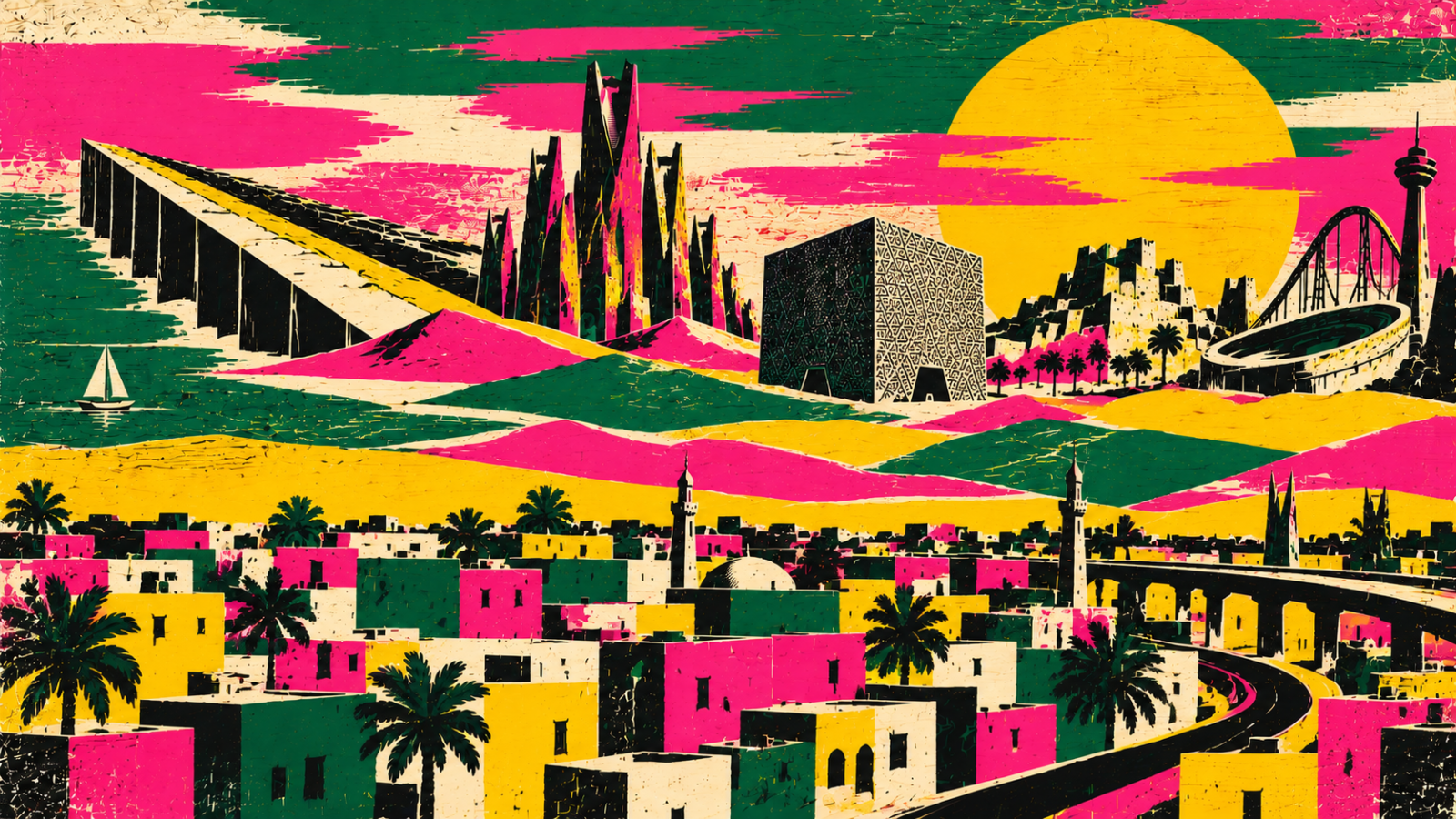
AI tools were uses for spelling and grammar and to improve expressions and the cover image.